Tuesday, June 5, 2018: The Irish Storytelling Tradition meets from 9:00 – 11:30 a.m. Monday through Thursday for the four weeks of the program. Since the first Monday of June is a holiday, our first class was on Tuesday. I met the students in the carpark outside our apartments at 8:45 a.m. to walk them across the street to the Athlone Institute of Technology, where the program rents a classroom. Two walls of the classroom are windows, one is bright orange, and the last is the front with a board and a screen. We had introductions and I tried to quickly memorize everyone’s name. We then did a story exercise called “Learn a Story Fast” that gets participants immediately into Irish stories and shows them that learning and telling a short story is a manageable and fun thing to do. We took a break and made a quick visit to the excellent AIT cafeteria. I then reviewed the syllabus, expectations, and homework assignments and it was 11:30 and time to go
Wednesday, June 6, 2018: Day two began with approximately half the class expressing concern about the amount of work that would be required between my class and Barry’s Irish Religion to the Middle Ages. Dr. Vaughan’s class covers Celtic myth and religion, including the Irish gods and goddesses, and the great Irish epic, The Cattle Raid of Cooley, and on into early Christianity on the island. In my class we study and tell the stories from the mythic cycles, the saint legends, and the folktales. Our two classes fit together perfectly. Participants do have a lot to read, and in my class they have something due every class period: reading responses, story summaries, and reflections after each story they tell in class. Both classes meet graduation requirements for those who will be applying the credits towards their degree: Barry's class satisfies the Humanities requirement, and mine qualifies for Global Awareness.
After reviewing and discussing my expectations for their assignments, we talked about the Celtic wheel of the year (cardinal directions, elements, seasons, time of day, and time of life), the Hill of Uisneach as the physical and mythological center of Ireland, and Athlone’s role in the middle of the country and of Irish history.
After a break, I taught them basic story structure, and provided them with a list of prompts to quickly craft a short story about themselves. We then moved the chairs into a circle. Each person told the story they had crafted to their neighbor on one side, and then again to the neighbor on the other. Several people were willing to then tell their story to the whole group. We talked about the role of personal and family stories in traditional storytelling. That got everything flowing again and people left class in a better frame of mind.
Thursday, June 7, 2018: The last day of our first week was devoted to preparing to visit Loughcrew on Friday and to them finding their stories to analyze and tell. Loughcrew is a Neolithic passage tomb complex spread over four hills in Co. Meath, about 34 miles of the Newgrange, the Unesco World Heritage site. Access to Newgrange is carefully controlled, but while Loughcrew is monitored by guides from the Office of Public Works, we are free to wander all over the site and enjoy the monuments and views.
The Irish name for Loughcrew is Sliabh na Calliagh. The students were assigned to read the blog posts I’ve written about Loughcrew over the years, and about the titanic goddess it is named for, the Cailleach. We reviewed their responses to the reading, and I told several stories about the goddess (How she and her sisters formed Ireland, how she made Loughcrew by dropping boulders from her apron, an alternate version of the story that includes St. Patrick, and The Best Walker in All Ireland, a folktale about her documented in the 1800s). After a break, participants had about an hour to read and look for stories they wanted to summarize and tell. I have a good selection of books containing Irish myths, legends, and folktales for students to use. Danielle Allison, an Athlone based teacher and storyteller, keeps them for me during the year and uses them as she needs to. Every year the collection is supplemented by a few from her collection, too!
Here are the posts from previous years that I’ve written about Loughcrew:
- http://irelandjournal.typepad.com/lizs_ireland_journal/2007/06/st_patrick_and_.html
- http://irelandjournal.typepad.com/lizs_ireland_journal/2008/06/there-really-ar.html
- http://irelandjournal.typepad.com/lizs_ireland_journal/2009/06/the-goddess-of-rocky-places.html
- http://irelandjournal.typepad.com/lizs_ireland_journal/2013/06/child-of-the-solstice.html

Since the students were concerned about “drowning” in readings, I thought this would be a good story to include in the post. M. Daly, a student at the Christian Brothers School in Athlone in the late 1930s, collected this story from his (her?) father. Lough Ree is a lake on the River Shannon just north of Athlone.
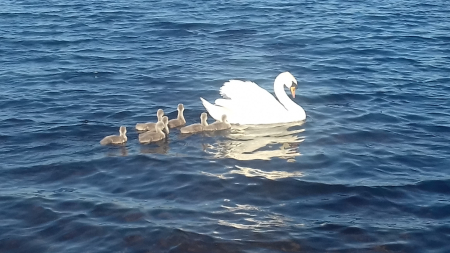
(The image above is the mermaid inside Clonfert Cathedral near Ballinasloe. The image below is a swan and her cygnets on Lough Ree earlier this month on a glorious sunny day.)
Leave a Reply