Sunday, June 3, 2018
We use one of the apartments in the complex as a computer lab. It’s on the ground floor in the block across the parking lot from the one we stay in, next to the manager's office. We met there at 10:00 on Sunday morning for our on-site orientation.
Jet-lag was much in evidence, but almost everyone showed up. Barry covered the basics: start a list of the things that need attended to in the apartments, where to go and not go in Athlone, class times and locations, general safety and logistics.
We met at 1:00 for the walking tour of Athlone. We walked from our apartments to Athlone Castle, and then to the lane of shops past the castle, and back around past the post office and the Garda (Police) station to the bridge. Below is our route:
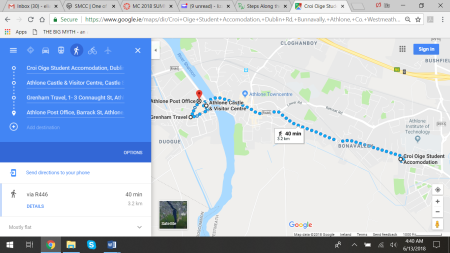
Barry leads and I bring up the rear to round-up stragglers. He paused frequently along the way to talk about the train, The Shack (his favorite pub),the Polish grocery and why there is one in Athlone, the milestone placed in 1780 marking the distances to Moate and Ballinasloe, and the Franciscan Friary. Once in the center of town, we walked down Friary Lane to the River Shannon. It was a glorious sunny day and scantily clad Athlone residents were sunning themselves on the benches along the river.
Barry talked about the crucial importance of the Shannon in Irish history as we admired the river, the 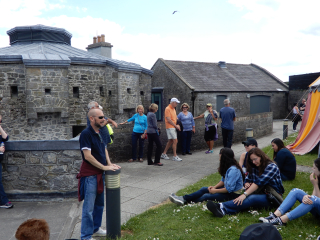
bridge, the lock, and the weir. We then walked over the bridge to the castle and as we crossed, we saw the Viking Boat heading up to Loch Ree and many houseboats with people lounging about to catch the sun. Once at the castle, we scrambled up to the highest point we could get to. We sat while Barry gave us a longer talk on the role of the castle and the bridge, and how the loss of the bridge in the Williamite War of 1790 had sealed the domination of Ireland by the British.
Down around the back side of the Castle is the old part of Athlone, containing Sean’s (the oldest pub in Ireland, dating to the 900s), and several other popular spots to eat and drink. Given the sunny warm day, all the places were hopping and there were lots of people on the street. It felt festive!
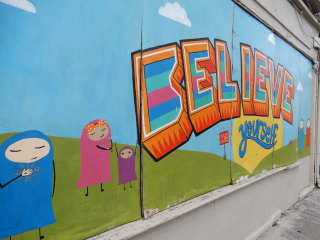 We walked around on Castle Street, which within a few steps becomes Main Street, and then High Street, and past a good stretch of shops and restaurants on O’Connell Street, including the Bastion Gallery, the nicest gift shop in Athlone. We then turned and went back up Pearse street to the bridge. Barry then released us to make our way back to the apartments as we wished. (The picture at left is a mural at the corner of Pearse and O'Connell streets.)
I walked back down to Dublin Road, the ancient road that links Dublin and Galway, to the taxi rank by the Prince of Wales Hotel. But there is massive road work in progress right in the middle of town and the road is closed to vehicles, so there were no taxis. I walked on east past my favorite pub, Flannery’s, and then turned south to Golden Island. Only one taxi there, but I hopped in and made it home.
I wrote about the Schools’ Collection in the previous post. The stories are all available at dúchas.ie. 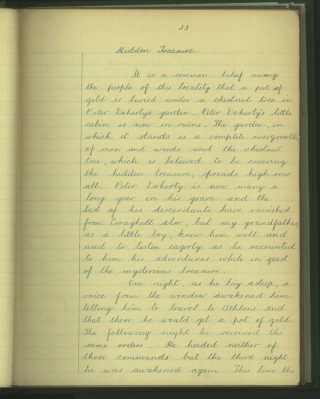 The Irish word dúchas means heritage, but also contains concepts like birthright, ancestral home, and kindred affection. The stories are still in the process of being transcribed, and anyone can apply to assist in the transcription efforts.
When I checked the website for stories about the bridge in Athlone, I found a fantastic version of a world folktale type, The Man Who Became Rich Through a Dream. In most of the versions of the story, a poor man repeatedly dreams he will become rich if he goes to a certain bridge far from his home. Once he gets there he meets someone who laughs when he hears about the poor man’s dream. He tells the poor man that he too has had a dream of riches beneath a great tree in the poor man’s home village. “But you won’t see me traveling all that way for a dream!” So, the poor many rushes home, because of course that great tree is in his own yard. The poor man digs up the treasure, shares with his neighbors and the church, and is poor no more.
The version from Dúchas is called “Hidden Treasure,” and it was collected by Annie Morgan from John Morgan, a 68-year-old farmer in Williamstown, Co. Galway, where the story is set. Of course, the Irish version is a little different, and no one actually gets the treasure in the end. In fact, the protagonist, Peter Doherty, who travels all the way to Athlone Bridge, loses two fingers when he tries to recover the treasure. My favorite part is when the storyteller asserts the credibility of his story: “The only proof my grandfather had of the truth of this story was that Peter Doherty lacked two fingers off his right hand ever after. No attempts have since been made to recover this hidden treasure because people fear the fate of Peter Doherty.”
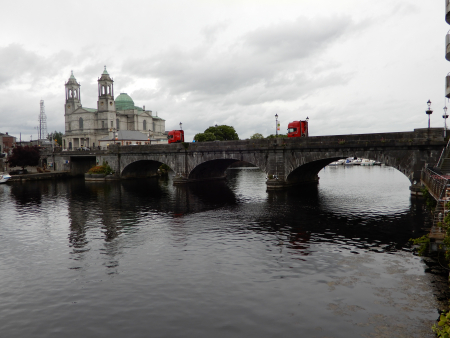
(Athlone Bridge on a cloudy day in 2017.)
Leave a Reply