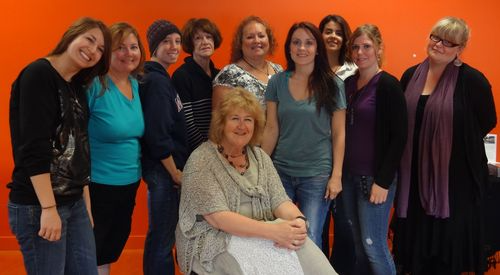
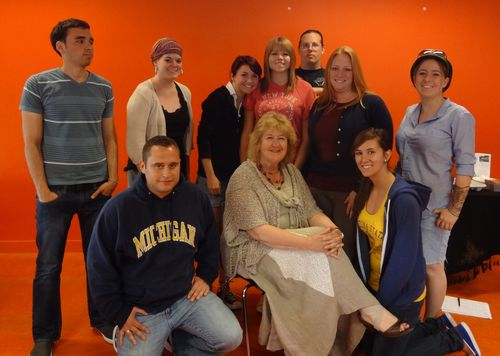
Liz Weir visited The Irish Storytelling Tradition as part of this year’s Three Rivers Storytelling Festival on Wednesday, June 15. She is the only teller who has visited my class every one of the seven summers I’ve been teaching in Study Abroad Ireland. It’s a tradition.
She started off by talking to us about her accent. Since Cushendall is only 12 miles from Scotland, she’s often told that her accent sounds more Scottish than Irish. But, she reminded us, in Ireland the accent changes about every 10 miles. So who’s to say what a true Irish accent is? And she also cautioned us against ever adopting a stage Irish accent, an admonishment they’d had from me on the first day of class.
She spoke to us about her philosophy and influences. She said that at this stage of her career she is more of a listener than a teller. “It concerns me that people aren’t so good at listening – I want to encourage that now for all ages.”
She then told us her first story. Since we are keeping count of the total number of stories told during the class, I’ll include the ongoing count in parentheses.
1. (56) To introduce the story of the girl who went to the hiring fair, she told us about Sheila Quigley, one of her most important influences. “One of the things I love is following in the footsteps of people who have come before me. Most people who step on the Carrick-a-Rede in Co. Antrim are afraid, but they walk on in the knowledge of those who stepped before them. It’s the same with stories.”
Liz told us that she is drawn to that kind of story. She said that storytelling increases the empathy in people’s lives. “It’s important that we create stories that touch your emotion. You have to be a human being to really appreciate it.” She likes to make people think and make pictures in their heads.
2. (57) She then told us a story with a folded piece of paper that turns from a boat into a t-shirt to demonstrate how engaging a simple story can be for almost anyone. She says they have great utility English language learners, for example at schools in Dublin where 65 languages are spoken. “The least confident child or adult can do that.” Tells in prisons she’s on to the next story and someone still doing it.
Liz grew up in a family before television. Her father made her sing with a bow on her head, and she hated it. When she began to work at the library, she was horrified when she learned she had to tell stories to children. She was the Belfast Children’s Librarian for 14 years while bombs were going off and people were being killed and “we just got on with it.” The children of Belfast had seen more violence than most adults ever will. “But no matter how fast they are forced to grow up they are still children and need stories. They still have a basic need for story. And it’s not just the story. It’s the time spent – the intimacy.
3. (58) She then told us the story of the young soldier who finds a used book, and contacts the previous owner, who conveniently left her mailing address in the back. She learned it from Rob Mann, who found it in the Readers Digest. She said, “I’ve heard 100s of stories and I didn’t see that ending coming!” She reminded us that we “have to find stories that suit you as a storyteller.” She said she wanted to “shut myself in a cupboard when I first saw Grace Haworth – Grace by name and grace by nature.” She realized, of course, why she couldn’t be Grace – she had to be herself. “Like a new pair of shoes, I have to walk in a new story to make it mine, to fit my feet, to fit me.” She would never change the sense of the story, but even a story like this one she adapted to fit herself.
4. (59 She told us the Red Riding Hood rap made by seventh graders and describe how she uses interactive strategies to engage children in creating stories and poems. More and more of her work knowing is doing just that in more intimate settings and with more marginal audiences. She told of her residency with a group of tough children in Monaghan. At first they told her that books were rubbish and that they wanted nothing to do with storytelling. Now, after several weekly sessions, next week they will be doing a performance. The principal told her he’d never seen anything like it. To demonstrate, she led us through the initial phase of the process by asking our impressions of Ireland. We’re looking forward to the poem she will create!
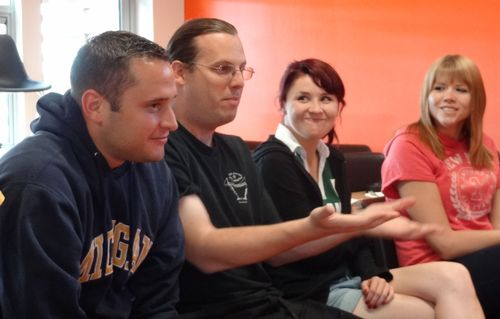
5. (60) Her next story is one of my favorites. It was created 8 and 9 year olds, with direction from Liz, and they call it The Chain of Memory. It’s a beautiful story of a family evicted from their thatched cottage in Donegal, the tragedies that follow, but how the American descendents return to complete the circle. They made it up after hearing Liz tell One Wish.
6. (61) To demonstrate the importance of knowing your audience, she told us the story of the new young minister who preached a full fire and brimstone sermon to one old man. When he asked the old minister for advice, the old man told him that when he fed the chickens, if only one hen showed up, he didn’t give her the whole bucket! “It’s important to read the audience and know who you’ve got. Storytelling is a living breathing dynamic thing.” She says she can’t work from a set-list for the same reason – how can you know what to tell until you see who is there?.
Someone asked her who her biggest influences were. She quickly replied that it was her mother. “She wouldn’t have called herself a story teller. And, she couldn’t believe I was giving up my good secure job to tell stories.” Alice Kane, the Belfast-born children’s librarian in Canada, who was also a renowned storyteller. When Liz met her, Alice said, “You’re the one with the Irish voice” Liz also mentioned Kathryn Windham, who just recently passed, “There would be no messing about – she just told the story. She had a presence in the room and knew how to own the space.”
7. (62) She told one of her signature stories, the fairy story set on Rathlin Island about the blackberry picking boy. At the end she said, “Our landscape bears the stories.” And, “You have to be nosy, and all your senses must come into play.”
Liz said that she had told stories in “the weirdest places: swimming pools, a boxing ring, squash court, and with soldiers holding automatic weapons. I came in to storytelling from working in the community. There was no lying in a darkened room before telling. There is an art, craft, and skill to it, but part of what I do is to de-mystify storytelling.”
She told us about the Crumlin Road Prison Visitors Center run by the Quakers. When she was a children’s librarian she was asked to tell stories to the children who came to the visitor’s center and then eventually to the prisoners themselves. In Maze Prison, she met Michael Stone who had killed the husbands of two women she knew. It was a very rough experience, but as the teller she had to keep it together. “Under the terms of the Good Friday agreement they’re all out of prison now. It’s a legacy we’ve had to deal with in Northern Ireland – both the victims and perpetrators side by side in their communities.” About telling stories to prisoners she said, “When they’re listening they’re not killing each other.”
8. (63) She was asked which poets had influenced her. She talked about the work Yeats had done collecting folktales and told us that Seamus Heaney, whose “poetry is rooted in the landscape”, had been her lecturer at university. After a dig at me about the rattlesnake that appeared a few weeks ago on the very patio she’d been sitting on at Christmastime, she closed with Crawford Howard’s great poem, St. Patrick and the Snakes.
Thanks Liz and see you next year!


Leave a Reply