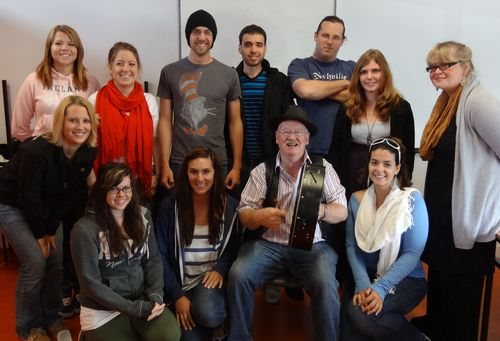
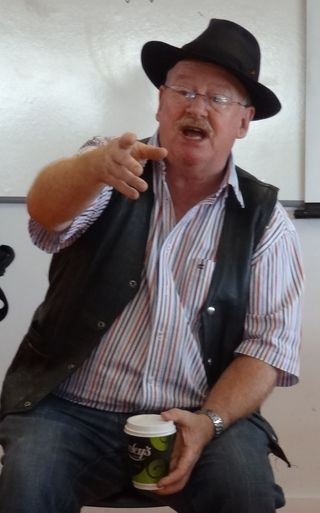
 The Three Rivers Storytelling Festival brought Pat Speight to my class on Thursday, June 9th. All of my students were there, plus six of the remaining twelve in the program. I was very pleased that so many of them got to hear Pat – The Hat, as he brands himself. Speight is pronounced just like eight. He told 16 stories, which I’ll detail below, which brings our total up to 37.
Pat started off by telling us that he was an “organic storyteller” with no professional academic training. I believe he means in the art of storytelling, since I know that he’s done his time in the folklore department at University College Cork. He charmed the students immediately by telling them that he has “too much respect for the truth to use it in everyday normal conversation. I’m not known for telling the truth”.
He gave us some background on himself and on the ancient tradition of storytelling in Ireland. Before he was a professional storyteller he’d been a carpenter, a ship-builder, a chef, and a salesman, to name a few. He said he would have told stories as a younger man, since in those days, and especially in rural areas, everyone had to have a “party piece”. It might be a story, or a song, or a dance; everyone took a part in community entertainment.
He explained the difference between the two Irish names for storyteller: seanchai and scealai. The seanchai (shan-a-key) told shorter tales along with local history and news. The scealai (shkay-lee) told the long epic tales, often with musical accompaniment. Pat classes himself as a seanchai and he says there’s a lot of rubbish said about how the seanchai traveled about as a paid performer and was “fed and fêted” wherever he went. On the contrary, he says that the seanchai was embedded in a community. He “had his own profession”, as farmer, tailor, or thatcher but would be recognized in his area for telling stories, especially on long winter evenings. The scealai was the one that worked under the protection of a patron and would have been based at wealthy homes and courts.
Pat then told us his first story. I’ll list the stories below, plus some of what Pat said in and around them. The numbers in parentheses refer to our story count for the term.
- (22) The story of the archer, as told by the rabbi to explain how he always has a story for every occasion. Pat used this to talk about one of the basic truths of storytelling – namely that a skillful teller can connect almost any story to any situation. He also talked about Eamonn Kelly’s influence on him, and how Eamonn, who was trained as an actor, began to tell stories with the persona of a storyteller. Eamonn had heard an old storyteller in Kerry, and then told what he heard at a “posh Dublin 4 dinner party after a show.” After that he began to get more and more requests for stories, and researched and developed a large repertoire. He was heard on the radio and seen later on television, and for Irish people of 50+ he remains the icon of the Irish storyteller.
- (23) A story he learned from Dan Yashinsky about an Excellent Pig. Pat told this story to demonstrate his point above by appearing to start off telling a story about phones and directions, which he then wove in to the story later.
- (24) He told the Japanese story of Urashima and told us how it was the same story as Oisin in Tir-na-Nog.
- (25) He slipped in the Finn McCool story of Youth, Strength, and Death, which among other things explains how Diarmuid got his love spot.
- (26) Then he told us Oisin in Tir-na-Nog, which ends with Oisin meeting St. Patrick. Pat told us that this one story shows “how we managed to kill pagan Ireland”.
- (27) He told the famous story of One Wish.
- (28) A quick joke about the man who wanted to be made irresistible to women and was turned into a chocolate bar.
- (29) A story about a woman who has three wishes, which involves a neutered cat. About this story Pat said, “Very bold. Very bold. Very bold.” They guffawed. I’ll say no more!
- (30) A story from the Jewish tradition that he learned from Joel ben Izzy, who he credits as having had a great influence on him. The story involves a shamus who comes to America and makes gazillions even though he can neither read nor write. After this story Pat explained why it’s important to be well paid as an artist: “It’s a matter of respect.” He also told us that a storyteller needs to pick his or her moment. The old saying, “A song before a story” is true, as the music sets the context and then the teller can slide right in.
- (31) A riddle: The man that made it never wore it and the man that wore it never saw it. (a coffin)
- (32) The story of the tailor who makes a coat, then a jacket, then a vest, etc. In his version he wins a bale of Donegal tweed in a contest. After he told it he walked us through the scenes as a way of describing how storytellers rely on images instead of words.
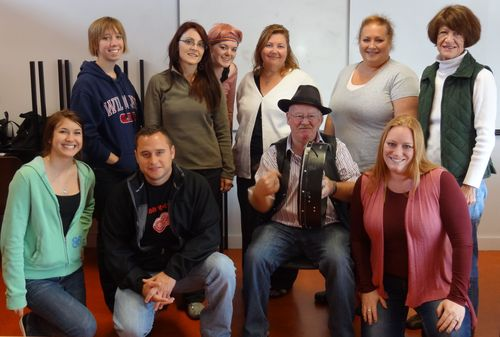
After this story he took some questions:
- How old were you when you first got paid? He deftly dodged this by saying it was 18 or 20 years ago
- What story do you tell first? “You have to see the audience.” He said starting a storytelling session with an audience is like making pancakes. “The first one doesn’t count.” The first one is like an icebreaker and gives the teller important information about the listeners.
- Do you get stage fright? Pat told us he was always a little bit nervous, but not too much. Even coming here, he said, was a little nerve-wracking. “I know it works, but I don’t know why.” He said it comes down to himself, the story, and the audience. He said there is no room for nervousness, drink, drugs, or exhaustion.
- What is your favorite quote? “Don’t buy green bananas”. (This was something that John Campbell was known to say. Pat and Danielle and I had been talking about this the night before. It was on his mind as he’d just suffered the loss of a dear friend.)
12. (33) A story about gravestones that had a particular date and time rather than a span of years.
13. (34) The Man Who Went in Search of His Luck. I really enjoyed Pat’s version of this story. He brought it around nicely to give a message to them: “Your luck is all around you. Just reach out and grab it.”
14. (35) The story of CuChulainn and Blaithnat, very nicely done – he made me want to tell it!
After this story Pat took a few minutes to talk about taking charge of the geography of the room. He advised us that your audience wants you to succeed. “You have to forget the words of the story. You need to have the story so well off that you can forget about the words.” Then, he says, you can be concerned with the job at hand, which is relating to the audience and managing the performance. “Your job is to deliver the story. The story’s the thing. No ego. No ineptitude. Be honest. Be fair. Don’t be patronizing. Then dance with the audience.”
15. (36) His favorite story, The Golden Ball, which he learned from Eamonn Kelly. When he decided to tell it, he called Eamonn to ask for permission. Eamonn told him, “Pat, I’m 80 years old and I won’t be taking them with me.” He gave us a little background on fairy lore, plus the statement of a Connemara woman, “I don’t believe in fairies, but they’re there.” The story includes the great Irish marriage proposal, “Would you like to be buried with my mother’s people?” The story was beautifully done, the best of the day in my opinion. Another one I’d really like to tell.
Pat then talked about the rules of using other people’s stories: You should always ask and you wouldn’t tell a story you got from someone else if he or she was in the room – unless they asked you to.
16. (37) Pat’s last story was about a king with four daughters. Before he leaves on a long journey he gives each of them a grain of wheat. Only the youngest plants the grain of wheat and gains her father’s praise. He linked that to the sharing of stories.
Two final quotes from our great session with Pat Speight:
“I never knew I had a deprived childhood until I saw the film Angela’s Ashes”.
“A story is a letter that you get from the past, add to, and then send on to the future.”
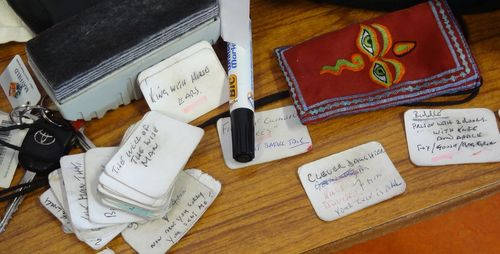
Below is Pat's repertoire system – a stack of well-thumbed cards with story names that he keeps in a little pouch he got in Nepal.


Leave a Reply