 Mammy, where’s me tay?
Mammy, where’s me tay?
I’m your pride and joy, your blue-eyed boy,
Though me hair is turning gray.
Mammy, where’s me tay?
Mammy, where’s me tay?
Your love for me, given tenderly,
Made me what I am today.
Mammy, where’s me tay?
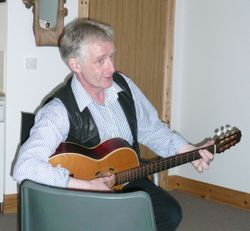
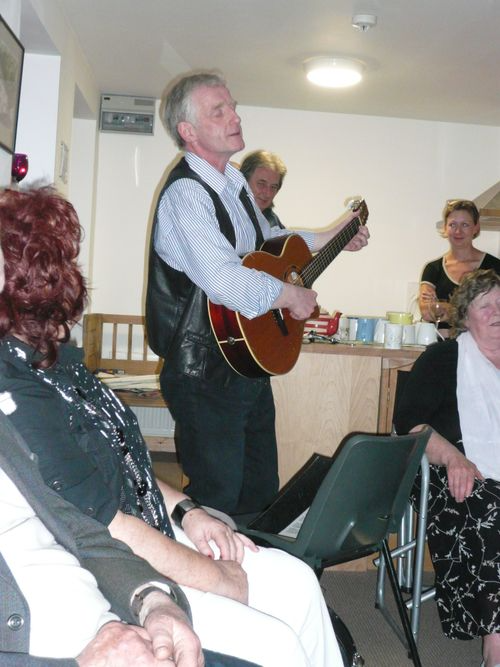
Last Saturday night, June 27, I was at the Ballyeamon Barn for the weekly session. One of the special guests Liz Weir invited was Declan Forde from Omagh, Co. Tyrone. Declan describes himself as “a teacher by profession, a poet by inclination, and a pauper by circumstance.” He’s also one of the most engaging performers, and persons, I’ve ever met.
Declan is very well known in Ireland, England, and the US. He writes much of his own material, and he is also an illustrator. He produced a program for the BBC called A Sense of Place, which you can hear here. The program features Declan and other poets and authors, including Ireland’s greatest living poet, Seamus Heaney. But the real focus, of course, is the subject: the relation of people to place which is so crucial to understanding Irish culture, life and art. In the beginning of the program, Declan describes his grandmother’s house, now abandoned. “No roof on it. All you see are the tops of the trees just pointing like dead men’s fingers toward the grey Tyrone sky. It’s desolate looking then. But when I stand here and look around it, what I think of are the people who lived here; the hearth where the people sat, and talked, and ate. There’s something timeless in it.” Give yourself a treat and listen, because to hear Declan speak it is much more satisfying.
Declan sang and recited poems, and then someone called out for “Mammy, Where’s Me Tay?” which I’m thinking must be one of his signature pieces. Just a few days earlier over dinner with Jackie Gorman and Brian Garvin of the Atlantic Corridor, Jackie had told us that Jesus was an Irishman. “He didn’t leave home until he was 33. His mother thought he was God. He thought his mother was a virgin.” So, to hear Declan sing this song just reinforced what I’d been learning about Irish men and Irish mothers. In truth, a similar song could be sung about Jewish mothers and sons, and let’s not forget those mothers and sons from Skull Valley and Gilbert, Arizona. The image of my brother in his early twenties dropping a dirty white shirt at my mother’s feet at 6:00 pm and saying, “I need this at 7:00”, is indelibly imprinted upon my memory. Do I need to add that the shirt was clean and ironed at 7:00 pm?
Declan’s song is not just about how Irish men are treated by their mothers, it’s also about how their wives take over the job once they marry. He describes the woman’s plight as a life sentence, caring for two children – one with a beard and one without. It’s one of those songs that makes you wince even as it makes you laugh; such is the truth it contains.
I’m very much looking forward to meeting and hearing Declan again in the future. “Tay”, by the by, is tea.


Leave a Reply