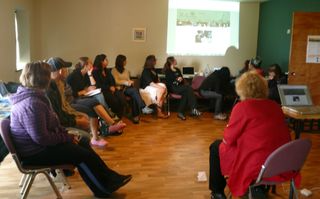
 Last Thursday, June 18th, I had the good fortune to spend most of the day with Liz Weir. She started off her day with my Irish Storytelling Tradition students at the Croi Oige Student Accommodation on the Dublin Road. Early afternoon she was in the Aidan Heavey Library, right next to the Athlone Towncenter Mall, telling to middle-schoolers. That evening at 8:00 p.m. she took part in the concert of Second Annual Three Rivers Storytelling Festival at the Prince of Wales Hotel, also smack in the middle of beautiful down-town Athlone.
She actually arrived in Athlone late Tuesday night, but she was telling all day Wednesday, and I had a party with the students that night, so I didn’t see much of her.
Thursday morning she spent the whole session, from 8:30 to 11:00 with my students. Introductions were made, and Jamaica Popejoy had to tell her second story. After that Liz entertained and educated us with stories of all kinds: folktales and legends, stories about storytellers, and descriptions of some of the innovative storytelling projects she’s created. It was one of the most satisfying mornings I’ve had in a long time. Here are some snippets of what she shared:
· When she was a young person, “Nobody could have told me I would be performing for people as a living.”
· She was working as a librarian in 1976 when American storyteller Bob Gash “brought great news to Belfast. In America people make a living telling stories.”
· The best storyteller is one whose story you remember long after you’ve forgotten the face of the teller.
· She told one of her signature stories, “The Rathlin Fairy Tale,” and her version of “Jack and the Magic Horse,” that she learned from John Collins. She also told us a wonderful story about a family that was evicted during the famine and how their survivors ultimately reconnected with them. The story was created, with her help, by a group of nine-year olds in Donegal and it sounds just like a legend that could have been told for centuries. They also created a poem to go with the story. It’s one I’d love to tell.
· She described the “Blue Horizons” project conducted with the Verbal Arts Centre in Derry. She worked with six adults who had been classified as learning disabled, or as requiring special education for their whole lives. “They had stories to tell but no one to listen.”
· She admonished us never to say that we “use” stories. She says that she “works with” stories and she sees her work as “provoking” stories. Her aim is to encourage people, to let them know “your story is important and you are valuable.”
· She told us another of her signature stories, “Mary and the Red Dress,” that she learned from Mary, a settled Traveller in Dundalk. I heard a beautiful line in it that I hadn’t heard before. As Mary walks down the lane, “the trees nodded like old men’s heads.”
· We turned on the computer and the projector so we could show cartoons produced by The Media Initiative for Children for which Liz wrote the scripts. The purpose of the series is to promote tolerance, and the titles include “Kim Joins In,” and “We Can Stop the Bullying.” They aired as commercials in Northern Ireland. If you haven’t seen them go here immediately. They are profound. Liz explained how symbolically packed each one is, from the accents of the children to the football jerseys they are wearing
· She explained that “it’s not stories by themselves that changes the world. It’s the actual act of intimacy of us sharing stories that makes a difference.”
· She reminded us to respect the origin and tradition of stories. “I don’t go with the melting pot theory of stories. We’re not all one. We’re different.”
· She told us one of my favorites, “The Lord of Benbow,” which she learned from George Sheridan, and can be found in his book When Turkeys Chewed Tobacco. About George she said, as is often said in Ireland of the great people of the past, “His like will not be seen again.”
· She told us about the dark sense of humor that the Irish have perfected. It’s that sense of humor that has helped them survive the Troubles and other desperate times. For example, someone seeing an ambulance speed by with its sirens wailing might say, “God, you’d not sell much ice-cream at that speed.”
· We turned the computer back on so we could hear Sheila Quigley, a storyteller from Derry tell us a story that had been animated by the BBC. You can hear it here. Click on the link right now, because you are in for a treat. It’s absolutely beautiful. Sheila Quigley is one of Liz’s standard-bearers and someone of whom she always speaks with much love and respect. The story ends with Sheila speaking as her child-self, “When I grow up I’m going to be kind, and lovely, and good like Mrs. Kane.” As soon as those words were out, Liz said, “And she did, she did.”
· Liz closed with a story called “A Wee Bit of a Lift” that comes from the Glens of Antrim where she lives. She said that it had a message that was especially relevant in these economic times. It’s about a couple whose farm is failing. A beggar comes by and miraculously gives them a bag of gold. They don’t want to spend it foolishly, so they carefully think through how to use it. In the process, they realize they have what they need to bring the farm back to productivity, and they don’t spend a cent. All they needed was “a wee bit of a lift.”


Leave a Reply