 The Storytellers of Ireland website is now live. On it you can learn about upcoming events and find contact information for most, if not all, of the storytellers I’ve been meeting and writing about.
On Wednesday night I had the opportunity to meet two of the Storytellers of Ireland that I’ve wanted to hear: Nuala Hayes and Niall de Burca. They were telling, along with Liz Weir and Eddie Lenihan, at an event called A Sense of Place sponsored by the Intercultural Relations Unit of the Dublin City Council. The event was held at the Project Arts Centre, right in the heart of Temple Bar. Also performing were Sadoo, half of a Senegalese music and story duo working in the griot tradition, and Hazim, an Iraqi poet and performance artist.
The six performers got ten minutes in each half, just a tantalizing bit of what they have to offer, but it was a truly enjoyable evening nonetheless. Eddie Lenihan told a story about a woman whose death revealed that perhaps she’d made a deal with “the lads”, or “the other crowd”, for the uncanny knowledge she’d possessed in life. In talking about “the other crowd” he said that he often tells people, “If you don’t believe in fairies you certainly can’t believe in God.” He said, “You’re cutting the ground from beneath your feet” because surely they both require a belief in some sort of “other world”. Later he told a story about a man who was balding – “losing a bit of the thatch” – and so he went to Biddy Early. According to Eddie, the healer Biddy Early was perhaps the most famous Irish woman of the 19th century and he described her as “fierce generous”.
Liz Weir was at her warm, natural, emotionally-present best. When she steps on stage, the audience is instantly enveloped in the mantle of her storytelling presence, and you can almost feel them relax into her confident care. Her first story was one that she learned from Sheila Quigley, one of Storytellers of Ireland’s Tradition Bearers. In the second half she told the story of her mother Nell Martin’s journey from India to Ireland at the beginning of WWII, and the tiny life jacket she made that saved a baby’s life. You can read more about Nell at this BBC site. I’ve heard both of those stories before and on this night she brought me to tears with both of them.
Niall de Burca was a delight, and at six feet plus, large in every sense of the word. Infectiously engaging and charming in person and on stage, I thoroughly enjoyed both of the stories he told. His first was about the three druids who prophesy that a coming rain will cause insanity. The rain comes, and the people do go insane. The druids, of course, stay well out of it. Ultimately they realize that as the only ones not affected by the rain, they will be regarded as the crazy ones, and they step out into the rain. His second was a personal story about overcoming his fear of swimming in the ocean, a fear that he lays at the feet of Steven Spielberg’s movie Jaws. “Steven Spielberg” he told us “ruined my life”! It was laugh-out-loud funny with dead on American, Belfast, and New Zealand accents. Beyond that, it was told with great glee and with passionate intentionality. This is a storyteller who intends with every word and gesture to relate to his listeners.
Nuala Hayes is an Abbey Theatre trained actor who has performed all over Ireland, Canada, England and the U.S. She has traveled even more widely with her storytelling career which began over 16 years ago. She is best known for her adaptation of Irish myth, and that was why I wanted to hear her. Her first story was about an Irish woman who was the last woman hanged as a witch in Boston in the 1600’s. Part of the reason she was convicted was that she refused to speak anything but Irish, even though it seems she was able to speak English. This turns out to be the first mention of the Irish language in an American context. Her second story was "The Curse of Macha", which I was hoping to hear her tell. I was excited to hear that she is working on a new piece called "Sightings of the Cailleach". I’m very much looking forward to hearing more of her mythic work. Her beautiful voice and polished presence are very well suited to such material. She’s very involved right now, with Jack Lynch, in producing the first annual Farmleigh Festival of Story and Song, to be held in the Phoenix Park in Dublin in late July. It’s an ambitious festival that will be featuring a full roster of tellers from Ireland and beyond. Unfortunately for me, I’ll already be back in Arizona and won’t be able to attend.
Sadoo and Hazim reminded us that the storytelling tradition world wide has always included music and verse. Sadoo played his guitar as he sang and told a story that a “djeli”, a traditional Senegalese storyteller would tell. It turned out to be the one about the man and woman who set a wager on who will speak first. Hazim (Al Ansary) read a poem in the first half, and opened the second half dramatically by emerging from a black suitcase placed in the middle of the stage. In this piece, called "Here and There", he told us in lines that served as a refrain that the story would mean nothing if we were not there. And it was true, I did not understand specifically what events he was relating. On the other hand, it was clear it was about the war in Iraq, and what it meant for him to be here while it was happening there. I imagine it was also a plea to us here, to realize that we weren’t there in any sense of the word – not in Iraq and not experiencing the devastation of war.
The audience was one of the most exciting parts of the evening, without a doubt one of the most diverse in which I’ve ever sat. There were Irish, American, British, and Spanish listeners. The people sitting behind me were Chinese and Italian, which I learned as they introduced themselves to each other. Aideen McBride, a Dublin storyteller and one of the organizers of the Yarnspinners, was there with several of her African neighbors in Ballymun with whom she is involved in a storytelling project.
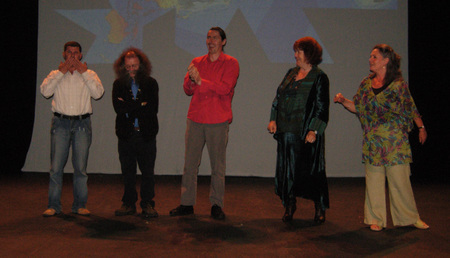
Below are the storytellers taking their final bow including Hazim, Eddie Lenihan, Niall de Burca, Liz Weir and Nuala Hayes.


Leave a Reply