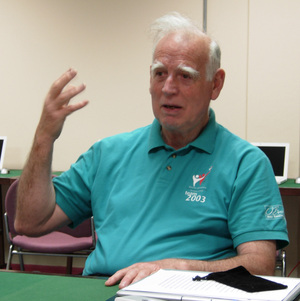
 Miceál Ross joined us in class on Monday morning. Miceál’s first career, which took him all over the world, was as a research economist. Later in life he attended University College Dublin’s famous Delargy Center for Irish Folklore to pursue his passion for story and obtained an additional degree. Although he recently relinquished the responsibility to others, for the previous several years he managed the Dublin Yarnspinners storytelling group.
As he has in the past when he’s visited my class, he spoke about strong women. This year his comments were enhanced by his recent reading in new biblical scholarship and in creation theology. It seems I’m not the only one with the Irish goddess on my mind. He started the session with the following comments:
“I said that I would talk about the strong woman in Irish tradition. It’s a funny thing, but when I come across things like new-age people, what have you, and with all this weird and way out there stuff – I hope you’re not new-agers, now – and they have all this sort of stuff they’re going on with. But the funny thing is that in the last number of years I’ve been starting to re-evaluate religion – religion in my life and so forth – and very recently I’ve come to a strong feeling. And it’s not just a felling, but it is a conviction, that there has been a strong woman looking after the Irish for 2,000 years. And she’s there and she’s looking after the Irish. And I’ve been reading the new biblical studies and what have you and I realize of course that our concepts of God and all that are bananas, and that this strong woman is an Irish expression of God in its own way. I really now realize that the new-agers were ahead of me in this regard . . .So, what I have done is trace over the period of time how this concept of the strong woman has come along and has informed the Irish over the years – how they coped with prosperity and with ruin. She’s there all the time looking after them in a funny sort of a way.”
Miceál said that her presence can always be detected in the stories and in the way that the stories are told. It turns out that the strong women in the stories are often otherworldly women. The health of the land and its people depended on a marriage between an earthly king and an otherworldly woman, both of whom had to be without blemish. Their united perfection was then reflected in the world around them which thrived as long as they did.
He told us several stories that emphasized this otherworldly aspect of the strong women in Irish story and myth. The first was “Macha’s Curse,” also known as “The Weakness of the Ulstermen,” a fore-tale to the epic “Cattle Raid of Cooley”, which explains why the Ulstermen can not defend themselves – in short because they have deeply offended the goddess – nine generations worth of offense, in fact. You can find the story here.
He followed that with the poetic description of Etain when first seen by her future husband, Eochaid, the high king. Eochaid could not rule without an otherworldly wife, and this is his first glimpse of her:
And Eochaid came to that place to take the maiden thence, and this was the way that he took; for as he crossed over the ground where men hold the assembly of Bri Leith, he saw the maiden at the brink of the spring. A clear comb of silver was held in her hand, the comb was adorned with gold; and near her, as for washing, was a basin of silver whereon four birds had been chased, and there were little bright gems of carbuncle on the rims of the basin. A bright purple mantle waved round her; and beneath it was another mantle, ornamented with silver fringes: the outer mantle was clasped over her bosom with a golden brooch. A tunic she wore, with a long hood that might cover her head attached to it; it was stiff and glossy with green silk beneath red embroidery of gold, and was clasped over her breasts with marvellously wrought clasps of silver and gold; so that men saw the bright gold and the green silk flashing against the sun. On her head were two tresses of golden hair, and each tress had been plaited into four strands; at the end of each strand was a little ball of gold. And there was that maiden, undoing her hair that she might wash it, her two arms out through the armholes of her smock. Each of her two arms was as white as the snow of a single night, and each of her cheeks was as rosy as the foxglove. Even and small were the teeth in her head, and they shone like pearls. Her eyes were as blue as a hyacinth, her lips delicate and crimson; very high, soft, and white were her shoulders. Tender, polished, and white were her wrists; her fingers long, and of great whiteness; her nails were beautiful and pink. White as the snow, or as the foam of the wave, was her side; long was it, slender, and as soft as silk. Smooth and white were her thighs; her knees were round and firm and white; her ankles were as straight as the rule of a carpenter. Her feet were slim, and as white as the ocean’s foam; evenly set were her eyes; her eyebrows were of a bluish black, such as ye see upon the shell of a beetle. Never a maid fairer than she, or more worthy of love, was till then seen by the eyes of men; and it seemed to them that she must be one of those who have come from the fairy mounds: it is of this maiden that men have spoken when it hath been said: "All that’s graceful must be tested by Etain; all that’s lovely by the standard of Etain."
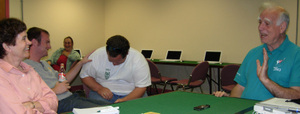
Miceál then treated us to several passages of his translation of “The Midnight Court” by Brian Merriman. The poem was written late in the 18th century, and describes a court presided over by an otherworldly woman who takes the men in the country to task for neglecting the women and their needs. He recited the stanza below with great relish, turning on the young men in the room and addressing the poem to them with vigor and delight. The picture above shows them in the aftermath.
The Court considered the country’s crisis,
And what do you think its main advice is –
That unless there’s a spurt in procreation
We can kiss goodbye to the Irish nation;
It’s growing smaller year by year –
And don’t pretend that’s not your affair.
Between death and war and ruin and pillage
The land is like a deserted village;
Our best are banished, but you, you slob,
Have you ever hammered a single job?
What use are you to us, you cissy?
We have thousands of women who’d keep you busy
With breasts like balloons or small as a bud
Buxom of body and hot in the blood,
Virgins or whores – whatever’s your taste –
At least don’t let them go to waste;
It’s enough to make us broken-hearted –
Legs galore – and none of them parted.
They’re ready and willing for any endeavor –
But you can’t expect them to wait forever.
When we returned from a quick break, Miceál told us about the banshee, which literally means woman of the sí, or otherworldly woman. In his introduction to the banshee and her importance to the Irish, he gave us this piece of wisdom:
“This may sound trivial, but in terms of modern philosophical discussion it’s very important. The Irish believed that this world was good and the early Bible said God created the world and it was good. And so their idea of the Otherworld was a good place and their idea of this world was a good place and the only time this world wasn’t a good place was when people screwed up this world.”
Miceál went to say that the idea of original sin, and that nettles sting and tigers chase gazelles is due to it, was not part of the Irish orientation to the world.
“The Irish didn’t buy that. They believed that this world was good. It’s quite a fundamentally different approach. If this world’s a mess, it’s not because it’s fundamentally a sinful place that has to be redeemed. It’s a mess because we make it so.”
After class, Miceál and I were sitting outside the classroom waiting for Danielle to come take him to the train station. I told him the story of St. Patrick and the Cailleach and asked him why he thought the Cailleach would have accepted a challenge from Patrick. “Ah,” he said, “Now, that’s a very interesting story, and actually a story of Lughnasadh.” Just at that moment, Danielle arrived to collect him, and I didn’t get the story! He called through the window as the car pulled away, “I’ll tell you the rest when I see you in Dublin.”
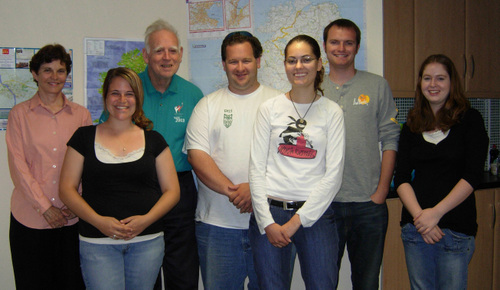
From left are Joyce Story, Ashley Dobbins, Miceál Ross, Sean Covington, Allison Davis, Jeff Asplund, and Amanda Ryder


Leave a Reply