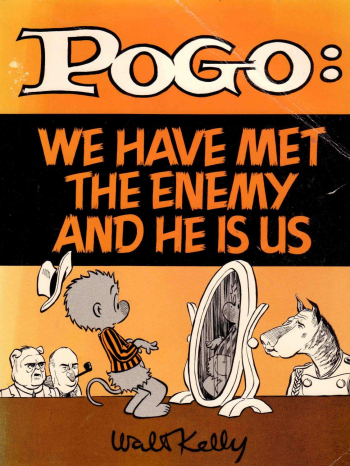
 Every story has a hero. We call that hero the protagonist. Every story has a nemesis. We call that nemesis the antagonist. The hero wants something. So does the nemesis. And in a twist often not clear for much of the story, the hero and the nemesis want the same thing. And in a further twist, the true nemesis is not the antagonist.
During the war of 1812, after the Battle of Lake Erie, Commodore Oliver Perry famously reported, “We have met the enemy and he is ours.” In an equally famous paraphrase, over a hundred and fifty years later, Pogo, a stumpy, somewhat pithy character created by cartoonist Walt Kelly, declares, “We have met the enemy and he is us.”
That moment becomes the reason for just about every story, the moment the hero realizes it’s not a matter of having more spells, or more bullets, more bombs, more allies, or better arguments. The moment the hero realizes the outcome is out of her hands, that the only event over which the hero has any control is her attitude, her thoughts, her response. The moment the hero accepts that truth is transformational. The hero may achieve her story’s goal, she may not. At that transformational moment, whatever the story’s outcome, whether the hero lives or dies, the hero has already succeeded.
Mindy Tarquini is the author of three critically-acclaimed novels featuring fables, foibles, fairytales, pandemics, past lives & lost loves. Find her and her social media links at www.mindytarquini.com
Leave a Reply