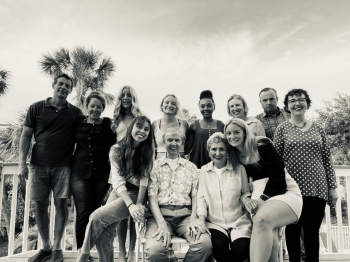
 I come from a long line of Irish storytellers. We love nothing more than to while away an afternoon over coffee, tea (or beer) talking… about anything. We talk about politics, we talk about what made us mad that week, we talk about the family, we tease each other (relentlessly) over our idiosyncrasies, but our best trick is to take the last big family argument and dissect it later for jokes. People who have witnessed this marvel at my family’s ability to move past our grudges so quickly. This, I reason, is because we love storytelling MORE than grudges. We make a game of who can construe the best story out of the last conflict, no matter how devastating the conflict seemed at the time. Who has time for grudges when you are racing to see who can tell the best story. We can’t wait to see who will spin our weaknesses into a story of redemption, who will make us laugh at ourselves, who will make sense of the senselessness.
When I set about trying to develop my first story for Liz Warren’s Personal Storytelling class, I planned to tell about an event that happened 40 years ago. I had a scrap of dialogue and a few sketchy details, so I called my brother and asked what he remembered about that Mother’s day. He said he only remembered what I had told him over the years. And my parents, who were also there on that Mother’s day, have from what I can tell allowed their scraps of memory to be swayed by whomever they spoke to last. I was alone to reconstruct the story from my own unreliable and vague memory. And then I got stuck. I couldn’t figure out how to construct the story without all the facts. I began to question whether I had a story at all.
Then I ran across a passage from Jack McGuire’s book The Power of Personal Storytelling where he makes this claim: “By engaging in personal storytelling, we unlearn a lifetime of subtle social conditioning not to think or act creatively.” It was true. I was surprised at how obliged I felt to tell the story accurately, chronologically, fairly. McGuire goes on to say that the biggest obstacle for “would be” storytellers is not “the lack of memories, low self esteem or stage fright. Rather, it’s a culturally induced fear of being inaccurate, or misrepresenting things, of failing to be objective, or of committing a lie.”
I quickly realized that in order to tell my story I was going to have to lie, well, not lie exactly, but I was going to have to somehow fill in the gaps, to make the story whole. Stephen King once said: "Stories are found things, like fossils in the ground … Stories are relics, part of an undiscovered pre-existing world." I love this twist on the idea of the truth. In this scenario, storytellers are going back to honor sacred ground, digging up dusty memories, carefully reclaiming and preserving the underworld of lost details. However foggy or degraded, these remnants of our pasts are powerful artifacts that help us make meaning of our past, present and future. Marilyn Torres says, “our stories are our birthright.” Indeed. They explain the world, each other, and ourselves. We need to fight for them.
And if in the end we still have holes in our stories, we can “act creatively” by cultivating devices like metaphors, symbols, and repetition to build on the emotional truth (as Liz Warren says) that lies at the center of our story. Like any artist, a storyteller curates the details. We pick up the shards of memory and start to piece them together like a mosaic. We decide what shape it will take and what pieces go where.
This is not a lie.
Daniel Taylor says, “True means accurately reflecting human experience.” What I have come to understand is that storytelling is a form of meaning making. It is a work of art. It is true.
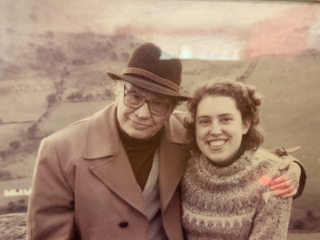
(The image at the top of the post shows Bridget with her family. The one at the bottom is Bridget with her grandfather in Dingle in 1981.)
Leave a Reply