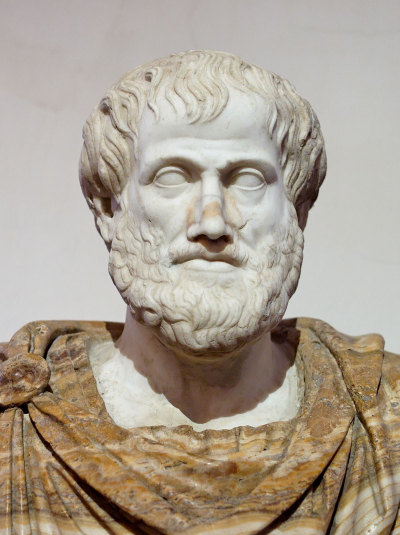
We storytellers have a lot to learn from Aristotle. If you’ve ever taken a class in communication, you’ve probably heard what Aristotle had to say on the subject in his classic, Rhetoric. Those of us who find that storytelling is an important way to advocate for a more just, loving and sustainable world should pay attention to what he had to say.
Aristotle agrees with Liz Warren (The Oral Tradition Today) saying that every communication event has three parts: 1) the speaker (storyteller) 2) the message (story) and 3) the audience. Easy. Right? Only he was Greek so he had to complicate the simple equation with some of those pesky Greek words—Ethos, Logos/Mythos and Pathos.
1) Aristotle focused on the Ethos of the speaker, which included things like intellect, character and good will. He wanted us to look beyond the seductive beauty of the Victoria Secret model or the rippled abs of the professional athlete. Do they really use the deodorant or is he/she just talking about it because they get paid to talk about it? Aristotle wants us to ask three questions of anybody who makes a pitch to us: 1) Does she really believe what she says she believes, 2) If she believes it do they also live it? 3) If they believe it and live it, what difference does it really make in their lives? These questions are good ones to ask ourselves we tell stories that embody our deepest values and vision.
2) The message included Logos (information) and Mythos (compelling story). Information is not enough. No lives have ever been changed by a pie chart. We need Mythos to touch the heart as well as the head.
3) Aristotle gave focus to the Pathos of the audience, which included intellect, emotions and relationships. We are so well defensed that we need to think about ways that our communication can get past the defenses we set against being challenged and changed. Storyteller Donald Davis suggests that one way to do that is through humor. Davis says the house of laughter and the house of tears are close to each other. If you can get into the (safe) emotion of laughter, you are closer to the other emotions that don’t feel as safe (tears).
Try this Aristotelian exercise: On a scale of 1-10, how would we rate your efforts at using storytelling to advocate for a more just and loving world? To be believed and trusted, the speaker needs to be perceived as “for” the audience, on their side, more concerned for the audience’s welfare than for self-gain or ego. The communicator’s Ethos is so crucial that Aristotle claimed it is “almost…the controlling factor in the persuasion!!!” On a scale of 1-10 how would you rate your honesty and integrity in the cause for which you advocate? Do we walk the walk or just talk the talk? On a scale of 1-10, do you think you are perceived as “for” the audience? What are some of the ways that we might help them perceive us as “one of them” or “on their side?”
For the Logos and Mythos of our Message, are we clearly informed and knowledgeable, 1-10. Are our stories compelling, 1-10?
We could do the same rating or evaluation for the Pathos of the audience. 1-10, Is our message tailored to touch people’s emotions as well as their intellects? Studies have shown that people are much more willing to respond if we tell stories about one person to whom we can relate, whose face we can see, in whose suffering we can identify, rather than telling a story about hundreds of such people, in the aggregate. We become overwhelmed and paralyzed by generalized suffering; but we can constructively help one person with our act, with our gift, with our vote.
For someone who lived 2.3 millennia ago, Ol’ Aristotle had a lot of good things to teach storytellers. It might serve us well to dust off our tattered copies of Rhetoric to see what the ancient Greek philosopher had to say.

Leave a Reply