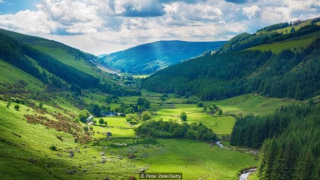
 Unless native to this land, we Americans all come from someplace else. If not brought here in chains, against their will, our ancestors packed their bags and made harrowing journeys across oceans and other waterways. They came for a dream of a better place, a freer place, a place to make a difference. Some came here to escape prejudice, famine, disease. They all had to come with great hope and a heart filled with desires, ambitions, and, poignantly, memories.
I know my ancestors did. Both my paternal and maternal grandparents crossed the Atlantic Ocean so they would not be penalized for practicing their Catholic faith. They came to escape the hunger that plagued their land. They came to provide for their children, and a future for new generations of their children.
Both sets of my grandparents came from Ireland before and after the Great Hunger of 1845-52, but that famine haunted them, and haunted us, their families. My paternal grandfather’s family settled in upper state New York in the early 1800s, where they farmed. My mother’s father was three when he came to New York in 1881.
It was my mother’s father we knew most intimately. We called him Dada. He was, my mother told us, one of the last of the Great Irish Politicians. We knew him when we lived in Yonkers, New York, and when he came to live with us in our sprawling Tucson ranch home, we could not have been happier. 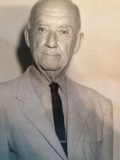
Dada was a passionate crusader for Franklin D. Roosevelt, and because of his work on behalf of FDR, he was appointed Postmaster General of Westchester County. Meanwhile, my father’s father had worked his way through law school and was appointed a judge in Manhattan. Both positions were patronage in the truest sense. Dada earned his important position for “delivering the vote” in Westchester county for Roosevelt. Grandpa Allen was part of the Tammany Hall Society, which helped him secure his judgeship. Established in the 1700’s, Tammany Hall became the most powerful Democratic institution in New York politics up until the 1960s. But most importantly, for Irish-Americans, it played a major role in helping Irish immigrants rise up in American society. (However, Tammany Hall subsequently became mired in corruption, and was one of many institutions that systematically oppressed Black Americans. But that is another story.)
I tell all of this because I never thought of myself as particularly Irish. Yes, I knew we were from Ireland, but my parents were New Yorkers. I was born in Yonkers. We lived, since 1950, in Tucson, Arizona. It was a bicultural community, rich in the history of its Mexican neighbors. I loved that.
My nine siblings and I were raised Catholic, but seriously “social-justice” Catholics. My parents’ friendship with the Catholic activist, Dorothy Day, brought her to Tucson over a ten-year period, as Dorothy and her followers began establishing Hospitality Houses in the worst sections of American cities. Dorothy was adamant that her Catholic Worker Hospitality Houses ONLY offer food and a place to sleep. Catholic hierarchy thought she should be evangelizing. She scoffed at that. “When people are hungry, you feed them,” she’d say, “it’s the only commandment that matters: love one another.” 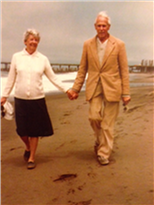
But the first time I traveled through Ireland in the late 1990’s, I felt such rage as I’d pass by large estates atop a hill. Other times, I’d feel such sadness at the edge of a bog. Those marvelous peat wetlands, I knew, helped keep our house warm. But still.
I had thought the “Irish Famine” meant we Irish could not get enough potatoes to eat. Which was true, when our Grandfather Cronin was a baby and carried in that boat by his mother in 1882. But I didn’t know much else, really. Plus, well, I don’t practice Catholicism anymore, which seemed to me a repressive religion passed on from generations of Irish clergy and nuns.
But, over the past few years, I let the mystery and beauty and sorrows of Ireland unfold. First, there were the travels through the country. The connections with distant Irish relatives. But then, finally, there was Liz Warren. This gifted teacher, storyteller, Institute director, focused our attention on the history, stories, myths, folklore of this land.
Now, finally, I can claim my Irishness. It is so much about keeping in one’s heart both joy and pain.
As I delved deeply into Ireland’s Great Hunger (1845-52), my heart was ripped apart. Finally, I understood the rage against the powerful who abuse that power, the rage against those who belittle the suffering of others, who make assumptions about why someone is poor, or hungry, or needy, or in despair. It is as if my ancestors called to me—and to my siblings, to their children, to all Cronin/Allen communities—to tell the story of what injustice does to a soul.
There is a well-known myth in Ireland about the Hungry Grass, or Fear Gortach. It’s a cursed patch of grass, on a desolate hill in Ireland, in which a person walking through it is suddenly, inexplicably, devastatingly, hungry. It’s best to bring a cracker, or a sandwich, or even a shoelace, when you walk through this area. A visitor to Ireland reports, as recently as 1990, that despite eating a huge meal in a nearby pub, her foray into this patch felled her. She was so weak with hunger, she thought she would perish. Remembering the small biscuit she had in her purse saved her.
The Irish Famine, it was thought, was a disease. The Hungry Grass didn’t just swallow people, it ate crops. It was thought that this might be the spirit of a man, eating people. If you gave relief to the Hungry Man, you would enjoy unfailing prosperity. Then it was thought that the Famine was the “Hungry Disease,” made by the fairies, or was grass grown over by a corpse. It is also said that these fields, these bogs, interred the corpses of men, women, children—who died with the 40 colors of Ireland’s green grasses of Ireland smeared on their lips, hoping to live but dying of hunger, of disease,, without food, without a decent burial. Hospitality, helping those in need, no matter your circumstances—that was all.
My ancestors brought their hopes and dreams to this country, of course. But it is their memories that I am most grateful for. To never forget that if we are lucky, if we have good health, if we have a modicum of wealth, we are obliged to serve others. But that is not enough. Give with kindness, with heart, with hospitality. Always, without judgement. That is the best way we know to honor the ancestors.
And to hold the powerful accountable for injustices done.
My Irishness rests in the hollow of my heart like a soft thumb, hurting for what others suffer at the hands of callousness and injustice. It connects me like an invisible thread to all who have ever been, or are being, hurt. But next to it, in that that special cavity, is joy. That part of me that loves beauty, language, music, art, community.
I may be an American, yes. I may have been born in New York. Been raised in Tucson, Arizona. But knowing my Irish history, its suffering, its pain, its joy, its gratitude. That, that has given my heart its soul.
Pictures: Will Cronin (Dada); Eileen Cronin Allen and Jim Allen

Leave a Reply