My favorite movie of all times is The Wizard of Oz. I remember seeing it as a little girl. My big sister was forced to take me, and then complained to our parents that all I did was cover my eyes, and scream.
Looking back on that time I realize the information being shown in that movie was just too much for me to comprehend, and it would take multiple times, and years of re-watching it, to even start to get what it meant to me.
Author Frank Baum was a horse of a different color himself. (I have frequently confessed that I am a purple horse trying to live in a field of brown horses.) And even though multiple people have suggested that the whole Oz stories are political satire from those times, I, on the other hand, feel that it is a journey through the Labyrinth of our lives.
Dorothy is a disobedient, rebellious girl being raised in a farm environment. She wants there to be more to life then this simple lifestyle, and wants the horrible neighbor who keeps threatening her little dog, Toto, with death, to in fact die.
In a weather circumstance of a tornado, and because Dorothy didn't make it to the shelter in time, the house and Dorothy are swept up and away. She rides the storm, lands, and realizes, “We’re not in Kansas anymore.” With one goal in mind, to get back home, the good witch appears and gives her traveling shoes, and instructions to just follow the yellow brick road.
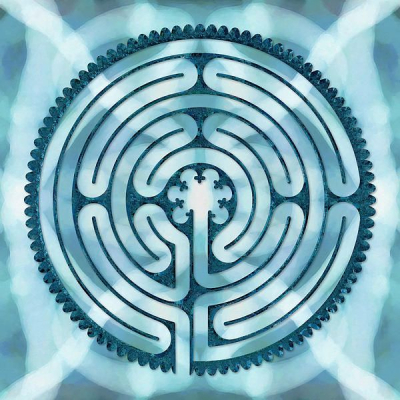
In the movie, the yellow brick road starts out depicted as a Labyrinth, and she's instructed to keep on its path. Along the way Dorothy runs into three others: The Cowardly Lion, the Tin Man, and the Scarecrow, who I believe were all parts of her subconscious mind. She ventures forth with her traveling companions to discover that she has courage, she has a brain, and she has a heart. After seeking advice from what turns out to be a fake prophet, she is taught that the answers have always been inside her; she just needed the journey of the road to discover that there is “no place like home,” home being a metaphor for completeness.
So, after hearing the song “Somewhere Over the Rainbow” while I was on a drive through Superior, AZ I had this urging to find a home. As circumstances and synchronicity sometimes collides, or colludes, I found this wonderful home. The owner was in the midst of his own tornado, and wanted out ASAP. While the house was in total chaos, much like the house after it landed in OZ, I knew it was going to be a vehicle of growth for me, and so I started my journey, and bought it.
Upon doing landscaping I came across rocks – hundreds of rocks – and being a hoarder, I decided to do something with them. So, I built a Labyrinth! Having walked the Labyrinth at the Franciscan Renewal Center, I knew that Labyrinths were about walking through a path that provided a way to go into ourselves and provided a path for reflection, a tool for peace, and subliminal guidance in a world that appears to have little to offer in these areas. While I was lugging, raking, and placing the rocks, a neighbor girl came over and asked what I was doing. After explaining, she came back a little later and said, "My mommy says you're a witch, “Well, if I'm a witch, I hope that I can be compared to Glenda, the good witch in the movie, who tries to help lost souls find their way back to their center.”
My Labyrinth is a six circle round based on the labyrinth in Chartres Cathedral in France. It should be understood that a Labyrinth is not a maze where one can get lost, and never find a way out. It is a journey into the center, and a return trip out; it has just one path taking one into, and then out of the experience. As Ursa Krattiger Tinga says, "The Labyrinth is a riddle. It is the cosmos and the world. The life of human kind, the womb of the earth. The journey, the way to the center, the way to ourselves.”
I encourage the walkers to write down a dream or a goal on a piece of paper, and pick up a black rock at the entrance to the Labyrinth, encouraged to lay their fears and hatred on that rock, and when it feels right to lay the rock along the path. When they get to the center of the Labyrinth there is a burning bowl, where they are encouraged to place their list into the fire and watch it burn upward out, into the universe.
And so, when I have my event, I do not insist, or preach, or imagine what will happen to anyone if they chose to walk the labyrinth. As Walt Whitman has said, “Not I, not anyone else can travel that road for you. You must travel it for yourself."

Leave a Reply