 Several years ago, Marilyn Torres and I began developing a list of memory prompts to help people in our classes and in the workshops we conduct to find story ideas.
We've learned that an effective story prompt brings a memory that documents a moment of learning, discomfort, emotion, awakening, resolution, understanding, or shifting perception – large or small. These are the memories that easily lend themselves to being structured into a story.
Below is a sample set of prompts. We adapt and update the list depending on the class or the client.
Try them out! Once you have a memory, try shaping it into a story.
Try Donald Davis' structuring devices*:
- The Five P's: Donald says that to make a Picture in someone's head as you tell a story, you must tell about the People, the Place, the Problem, and the Progress. We often add a 6th P for Point.
- The Inverted World: This starts with describing the normal world (people, place, time). Trouble comes to that world and turns it upside down (problem). Somebody learns something new or gets some help (progress), and a new normal world is established (point).
Or, try "How Something Came to Be":
- Describe how things used to be
- Describe the changes that came. Could be the changes of a moment or over a longer period of time.
- Describe how things are now and why it matters.
Finding Memories for Stories:
|
You and your friends got in trouble in school or college |
|
You were caught in the middle between two friends |
|
A rough beginning to a good friendship |
|
You survived, or didn’t survive a rough patch with a loved one, a colleague, a partner |
|
A misunderstanding led to deeper understanding |
|
You had an experience that helped you understand the power of community capacity building |
|
A date or an appointment or a meeting went wrong |
|
You said yes to the wrong person |
|
The moment you knew you were on the right path – what happened, how did it change you? |
|
A moment of inspiration or understanding that made a difference for you |
|
Someone who believed in you and your path – what happened |
|
A mentor who has guided you, opened doors for you |
|
Someone you admire and how they inspired you |
|
A key obstacle to you becoming who you are today and how you overcame it |
|
Something you worked very hard on turned out great – or didn’t – and why. |
|
A story of a health care tragedy that didn’t have to happen |
|
You learned a new strategy that made a difference for a client, or the community – what happened? |
|
You embarrassed your mother (or father, siblings, spouse, children) |
|
A client of yours inspired you – what happened? |
|
You were embarrassed by your mother (or father siblings, spouse, children) |
|
You needed to be rescued or you rescued someone |
|
You witnessed a specific example of the power of healthy community design – what was it? |
|
You had to make a mid-course correction – what led up to it and what did you do? |
|
You had an experience that helped you understand the root cause of a community issue or problem – what was it? |
|
Your most interesting relative – what they taught you? |
|
You didn’t get blamed when it was your fault – or you did get blamed when it wasn’t! |
|
A story of unlikely or unexpected community collaborators – what did they do and how? |
|
You broke or damaged yourself in some way |
|
You learned a family secret |
|
You got in big, serious trouble |
|
You lost your temper or you caused someone to lose his/her temper – what happened? |
|
You misjudged someone, or you were misjudged – what happened? |
|
An incident that brought your family closer – or pushed them apart |
|
You needed help and you got it |
|
The joke was on you |
*Telling Your Own Stories by Donald Davis, August House 2005.
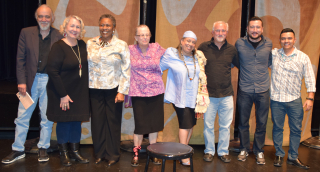
The picture at the top shows Marilyn (light blue in the center) and me (second from left) with the rest of the Storytelling Institute Faculty, and visiting storyteller Jim May (far left).

Leave a Reply