 Whenever I hear a very compelling storyteller I wonder how they know just the right story for that particular time. I have had that question in the back of my head during all of my classes and I have to say that reading Letting Stories Breathe by Arthur Frank has provided some insights. Frank says the question isn’t what story to tell but rather how to let the stories do their work for and on people. Early in the book Frank talks about several capacities of story.
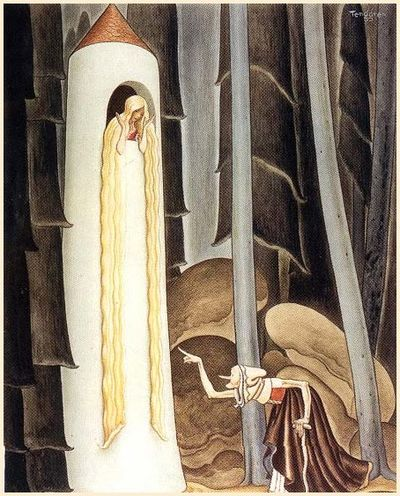
I like to examine Rapunzel in the context of its capacities. As Frank says all stories have “trouble” – a disruption in the usual course of events that causes everything to go awry. In Rapunzel there all kinds of trouble. For instance a couple who has been unable to have children finds themselves pregnant and the husband has to deal with a different wife. The story goes awry for him and he chooses to steal his neighbor’s rampion in order to satisfy his wife’s cravings. The story goes awry for the wicked witch first of all when she takes the baby and secondly when the baby grows up to a young woman. It’s an interesting question to ask: is she being mean for locking Rapunzel up or she being an overly protective mother hoping to shield her daughter from the trials and tribulations of adulthood? And what about the Prince? His life goes awry when he hears a maiden singing in the woods and he’s compelled to woo her. I’m sure if you asked him, he expected to be courting princesses in the splendor of their courts. And his life really goes awry once he’s blinded.
Frank says that all stories have characters and that a good story allows us to display and test the characters to see what they’re made of. As the teller relates a story she allows the listener to examine how the characters work out their trouble and decide whether they could be that person and if they would respond in the same way. The listeners are also able to see and feel and hear the impact of the social setting in which the stories are told and thus to strengthen or question “their belongingness”.
A good story has a point of view from which the story is told that it also has a capacity to be viewed from other characters’ point of view. This allows people to empathize with characters and gain an understanding their motives. Sometimes listeners empathize to the point of negating other points of view and the story becomes destructive to the social structure of a group.
Suspense is another important capacity of story. Frank describes suspense as a tension between different possible outcomes – to be hoped for and others to be feared. Suspense is the element that engages people, causing them to get caught up in the story. Suspense also expresses central moral truths and stories give the listener the ability to imagine how things might have turned out differently.
Another important quality of story is its interpretive openness or its ability to narrate events in ways that allow different possible interpretations of what happened and how to respond to it. This quality of openness allows listeners to see several points of view in their social setting and accommodate a range of different points of view within the group. It allows different people to hear different things from the same story. Or the same person to hear different things from the same story at different times. The wicked witch might hear the Rapunzel story when the child is young and see herself as a loving mother but here the story years later and see the child as an ungrateful daughter.
The final capacity in Frank’s evaluation of how stories work is the “out-of-control” capacity. By this he means once a story is told it is free in the world to do its work and each listener is free to respond in the way they hear it. The teller and the story have no control over how listeners take the story and how it affects them. The story is free to do its work or its damage on its own. I can’t help but wonder what Rapunzel would sound like if it was told from the point of view of an unwed mother wandering in the desert trying to care for children. Or perhaps from the point of view of the husband who tried to keep his wife happy and as a result lost the child that he longed for. Now that’s a good story: it keeps your wondering!
The image at the top of the post was found here: http://sashastreet.blogspot.com/2010/09/favorite-things-four.html


Leave a Reply