One of the major objectives for this semester was to develop a repertoire of stories especially representing my heritage. My brother had done our genealogy several years ago so I contacted him and asked him exactly where our family came from in England. His answer surprised me because I thought we came from the South Western part of England but instead it was the northeastern coast. There is still family remaining in the Manchester and Louth area which is near the eastern coast of central England.
When I was sorting through my mother’s photographs I came across an old family picture in the original frame from the studio where it was taken. It meant nothing to me but as my brother did his genealogy he came across a “cousin” (don’t know how many times removed) who lived in Louth. After hearing about her I sent my brother the picture and frame and he sent a picture of it to this “cousin” and asked if she recognized it. To both of our surprise she said the studio still existed and she had asked the current owner if he had old negatives or remembered anything about the studio at that time. Unfortunately it was not the same family that owned the business then and they couldn’t make a connection other than verifying that yes indeed the picture and frame had been taken in that studio and the woman in the picture was probably my great-great grandmother.
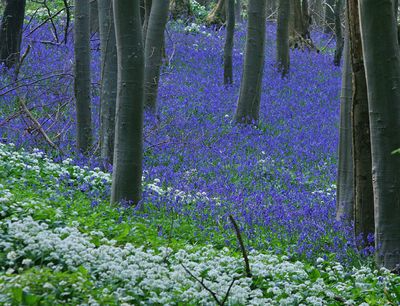
This sleuthing about where my family came from and going back over some of my vacation photographs from a trip to England certainly help me with imagining the setting for the Jack tales. My grandmother used to take me out to a place in the country on a small Sandbar Island in a little river each spring around Mother’s Day. The little island was out in the middle of a pasture but because of the water surrounding the island the cattle did not graze there. At this time of year the little island was covered from beginning to end with Bluebells. Bluebells are plants about 12 to 15 inches tall with sprays of little bell shaped flowers of soft sky-blue with pink edges. When the breeze blows the flowers shake in the air and my grandmother always told me if I listened I could hear the music of the bells.
This was a favorite memory of mine and I’ve tried several times to find Bluebell Island and have never been able to do so. I visited England early in May and as we left the airport and drove through the countryside I couldn’t believe my eyes. The woods were filled with bluebells blowing in the breeze just as I had remembered them from my childhood.
On the Internet I found some of the originally collected English Jack tales and as I read them I could picture the characters going to the woods, up and down the lush hills and living in the little cottages with the thatched roofs. As I read further I learned that the Jack tales moved from England to the Appalachian Mountains when the Scots, Celts and English immigrants moved to Appalachia.
Joseph Jacobs published a collection of the Jack tales that he had collected in England. This collection included Jack tales from Ireland. The University of Pittsburgh collection of folk tales includes some of the same stories and references a number of other tales that have similar motifs. They include similar stories from the Netherlands, Africa, and Germany. The Jack tales also had a long history in Appalachia and were favorite tales around the table or lantern at night. Donald Davis collected a number of the southern Appalachia Jack tales and published them. It was interesting to see how the stories morphed over time and in different places.
There is a female counterpart of Jack by the name of Molly Whuppie. Molly was a strong resourceful girl and a heroine of her stories as she solve problems and rescued her sisters oftentimes outsmarting giants and kings much as Jack did. I’ve enjoyed the semester’s reading and have a connection and kinship to the stories and I look forward to continuing my study of these characters.
The image at the top of the post is of bluebells and wild garlic in the Kings Wood in Dorset, England. http://www.surfbirds.com/community-blogs/DD/2007/04/27/kings-wood-english-bluebells-and-wild-garlic/

Leave a Reply