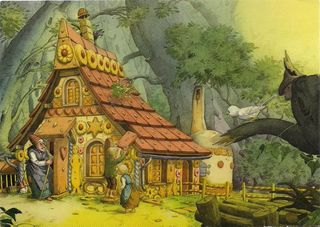
I had no idea that
people put so much thought and analysis into folktales until I read the Hansel
and Gretel chapter of New Tales for Old, by Gail deVos & Anna E. Altmann.
My initial reaction is “These people have too much time on their hands!”
But because I am not a very deep thinker, their observations point things out
that I may have missed entirely. And that is a good thing!
I
found the comparisons between the original manuscript and the Brothers Grimm
versions of stories very interesting. Having the differences in the
versions pointed out was useful in understanding the evolution of the
story. Changing the wicked mother into a stepmother, adding religious
symbolism and comments about their reliance on God, and making the father out
to be a “good guy” even though he went along with his wife’s plot to abandon
the children all seem to be efforts to make the story more politically correct – even back then! It is clear that the
stories are influenced by the times, and I am certain that in some regard, the
times are influenced by the stories as well.
Crossing
the water with the aid of a duck is a zany add on, in my shallow mind, but
turns out it is the symbol of a helpful motherly replacement according to the
authors. And the oven is a symbol of the womb! Who
knew!? I may always depend on other deep thinkers to point these
things out to me – or maybe in time, I will start to see the symbols for
myself. In any event, just reading some of the social and cultural
history of the story is causing me to think differently about it, and to take
less for granted. That too, is a good thing!
(BTW, I get a kick
out of how they call them The Brothers Grimm. Can I be one of the Sisters
Borg?)
The image at the top of the post can be found here: http://postcards2lufra.blogspot.com/2012/05/hansel-gretel.html


Leave a Reply