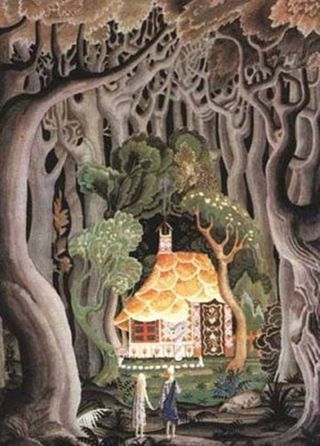
 Hansel and Gretel is one of the most well known and beloved fairy tales in all the world. But many people do not realize that several versions and variants of the story actually existed before the ubiquity of the popular Grimm version of the Hansel and Gretel tale that we all know and love today. One precursor to the famous Grimm tale of "Hansel and Gretel" is the story of "Ninnillo and Nennellla" (1643), written by the Italian folklorist Giambattista Basile.
The story's beginnings are familiar: A selfish stepmother and her weak husband abandon their two young children in the woods in order to conserve food and to save themselves from starvation. Their reluctant father sets out trails for them to follow back if necessary – the first of ash and the second, of bran. But alas, of course, the second trail of bran is eaten – this time by a "jackass" and the children are consequently lost in the woods – but this is where the strong parallels between the two tales come to an end. There is no gingerbread house and no evil witch in the Basile story. Instead, the children are separated – Ninnillo is found by a prince and Nennella is kidnapped by a pirate. A huge magical fish is also involved in this comic tale. Without revealing the ending, the tale is quite a fantastical and entertaining one.
Other earlier literary folktales which resemble "Hansel and Gretel" come from the French. Charles Perrault's "Le petit Poucet" (1697) or "Little Thumb/ Hop O' My Thumb" and Madame d'Aulnoy's "Finette Cendron" (1721) contain some similar elements as the Hansel and Gretel tale, such as children abandoned in the wilderness and coming upon a cannibalistic creature -an ogre in one case and a giant in the other- which must be killed before the children can escape and live happily ever after. Interestingly, the Grimm "Hansel and Gretel" tale itself went through numerous edits and revisions between the original manuscript, the 1812, 1819 and 1857 versions. The oral tale was first told to the Grimm brothers by a Dortchen Wild, a neighbor of the brothers who later became Wilhelm Grimm's wife. Wilhelm was the principal editor of the tale and he apparently revised the story several times, making significant changes and additions to the tale.
Critics point out that Wilhelm edited the tale over the course of over decades to make it more dramatic, more literary, and probably more acceptable to his audience. All in all, I wonder what factors inspired his changes and how these precursor tales influenced him in his revisions. This fascinating history almost begs the question: So which is the true "Hansel and Gretel" tale?


Leave a Reply