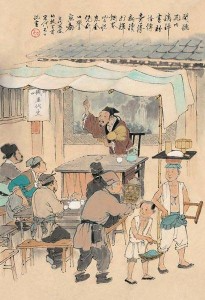
 As early as 1500 BC stories were being recorded in China. A famous poem of the Han dynasty (BC 202-AD 220) was “Far in the Sky”, popularized again in the Tang dynasty (618-907AD) as “The Cowherd and The Weaving Girl”. The retelling of this story exists today in many forms. The story is the basis of many Chinese festivals, including the most romantic one Qixi (chee shee) Festival celebrated on the seventh day of the seventh lunar month. That special day is known as the Chinese Valentine's Day.
Oral traditional storytelling is synonymous with song, chant, music or epic poetry. The street performers were the lowest level "artists of the bazaar" and the highest level were the narrators of history and in between were the tellers of ghost and love stories. Stories were told over a 100 days for 1-2 hours each or 12 days for 2 hours each.
In the 1700's, storytellers formed guilds to give members an official status, regulate who could tell in their territory, and to control fees and conditions in the teahouses or story houses. The 1800's saw construction of storytelling halls, shuchang, which held 80-100 people. The style of telling was speaking and singing. There are 56 ethnic groups in China and each area had their own style for storytelling. Pre 1949, apprenticeships and guilds were the learning forums, now the state runs academies and troupes.
A collective style known as pingtan was established in the 1950's with two distinct types of performance. The older style is pinghua or pingshu in Northern China, narrative with dialogue and no music. The other style is tanci, told with dialogue, narration, singing and accompanied by musical instruments and one to three performers. The storyteller wears a long gown, stands behind a table and holds a fan in one hand and a gavel or object reflecting the story and uses both for emphasis and to enhance the effects of the performance. The musician sits on the side.
In the early 1980's a revival of pingtan resulted in the reopening of the Suzhou Pingtan School. The curriculum entails three years in the classroom, with classes in performance skills (singing, musical instrument), and academic (literature, history, politics). Students engage in coursework, study with a master for three to six months, sit in on the performances and gradually participating in the telling themselves. Graduation came after performing the piece in public. Since the poems or stories were long and could take months to tell most master storytellers had a limited repertoire of one or two long stories, with a few medium-length and short stories.

Leave a Reply