I knew the concept of the trickster was widespread in many cultures, but I was excited to learn how important the concept of the trickster has been in American culture, up to and including the 21st century! If you’ve done much research on the Internet, you know that even a few minutes on any topic can set you spinning into “information ecstasy” or “overload agony.” My advice – never let the www know you’re afraid!
There are two specific types of trickster tales I admire a lot. Of course, both these types of stories occurred in other cultures prior to ours. I’ll start with Jack Tales, which in this country spring from
Grace Toney Edwards of Radford University maintains a website called Wonder Tales in Appalachia. The following two paragraphs are especially helpful to understanding Jack. The first links Jack to the hero pattern. The second reveals Jack’s role in fostering democracy.
“Jack is a character, usually a young boy or teenager, who is central to many of the wonder stories that get labeled as Jack Tales. But because Jack pops up so frequently in this type of story, his name has come to be the generic signal. Jack's stories almost always follow a formulaic pattern: Jack is the underdog or scapegoat who goes out into the world to try to make his way alone. Invariably Jack faces challenges that his brothers, Will and Tom, fail; but he surmounts them, usually by means of a supernatural helper (such as a bull's horn or a tablecloth or a cowhide). These appear to be ordinary objects, but they have been endowed with magical powers and given to Jack, typically because he has shown human compassion somewhere in his lifetime. With the help of his tokens, then, Jack passes the tests, wins the stakes (usually gold and a pretty girl), and "goes on up to the clearing where he's got him a little house." The storyteller is apt to end with words like these: "And the last time I was up there, he was a-doing pretty good."
“The great social leveling process, for which Appalachian Mountain people are renowned, works to make a king as accessible as a blacksmith. Jack, for instance, may walk right up to the king's house to find his highness sitting on the porch. Jack says, "Howdy, King. Have you got ary job of work for me?" And so the plot is off and running. And the listener, or reader, is hooked as he labors with Jack through the cleaning of the Augean Stables or drops with him into the underworld in an adventure paralleling Beowulf's search for the old fire dragon. Here is fantasy, rich, full, and living abundantly in the
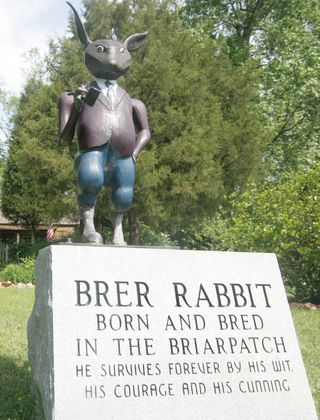
In addition to Jack, my other favorite is Brer Rabbit. One place to explore opinions about the trickster rabbit is to look into this website about Joel Chandler Harris and the Uncle Remus Tales, which includes some of the contradictions involved in the topic of the powerful and the powerless.
The question has been asked if Joel Chandler Harris was passing on his “collection” of Brer Rabbit tales in the Uncle Remus Tales as a protagonist for the reinstatement of slavery in the South. Again, there is a world of information on the internet in which to explore this question. What do you think about this controversy?
This site shows a sort of blog of opinions about various trickster tales. It’s worth a look.
Have fun with the Trickster. He (or she) is always up for a good time!
Photo of Brer Rabbit at the Uncle Remus Museum is from Georgia.org


Leave a Reply