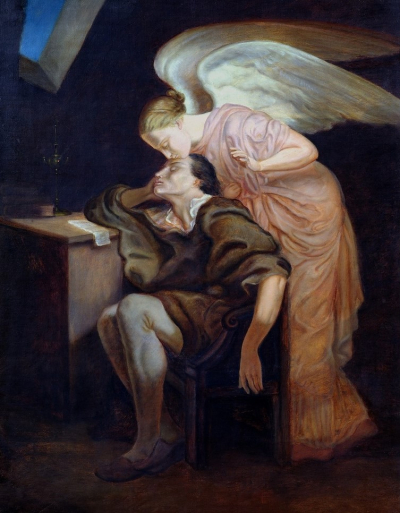
Would you recognize the folktale muse if you met her on the street, or in your dreams? When I was first becoming a storyteller in the mid-nineties, I went to the National Storytelling Festival in Jonesborough, Tennessee. I was overwhelmed with the range of storytellers and stories that I heard. I heard Elizabeth Ellis for the first time there. I was deeply impressed by her straightforward, commanding style of telling.
The night I returned home I had a dream. I was standing at the base of a steep hill with a straight path leading to the top. I knew the hill represented my desire to become a storyteller. I couldn’t take a step; I began to cry that I couldn’t do it. As I watched, the top of the hill transformed itself into Elizabeth Ellis. This Elizabeth had long black hair instead of white, but I knew it was her. She glowered down at me with the same commanding presence I’d witnessed at Jonesborough. She didn’t say anything, but in my head I heard, “You will do this.” I started up the hill and the dream ended.
My inner muse had taken the form of Elizabeth Ellis so I would listen to her. Ever since then, I’ve been drawn to folktale tellers like Elizabeth Ellis, Gay Ducey, and Liz Weir. They all have strong, masterful, unembellished styles of telling. But there are many different styles of folktale telling, inspired by a panoply of muses. SMCC’s 2009 Spring Storytelling Festival featured teller is Donna Washington. Donna’s style is strong, masterful, and embellished with her ebullient and kinetic interpretations. Willy Claflin, our Tell Me Something Good featured teller, fractures his folktales for telling by Maynard. Maynard is a moose puppet, and beyond that the last of the famed “Mother Moose” tellers. Folktales have a dynamism and plasticity that allows them not only to survive, but also to thrive in an incredibly diverse range of oral and written styles.
My muse became my model for telling in general, but the inspiration for telling a folktale can come in many ways. Perhaps through a real-life interaction with another person, a moment in nature, or an encounter with a beautifully illustrated children’s book. Tell us about your muse. Or tell us your inspiration for becoming a storyteller, or for telling a particular story. (The image at the top is Paul Cezanne's "The Dream of the Poet, or The Kiss of the Muse)


Leave a Reply