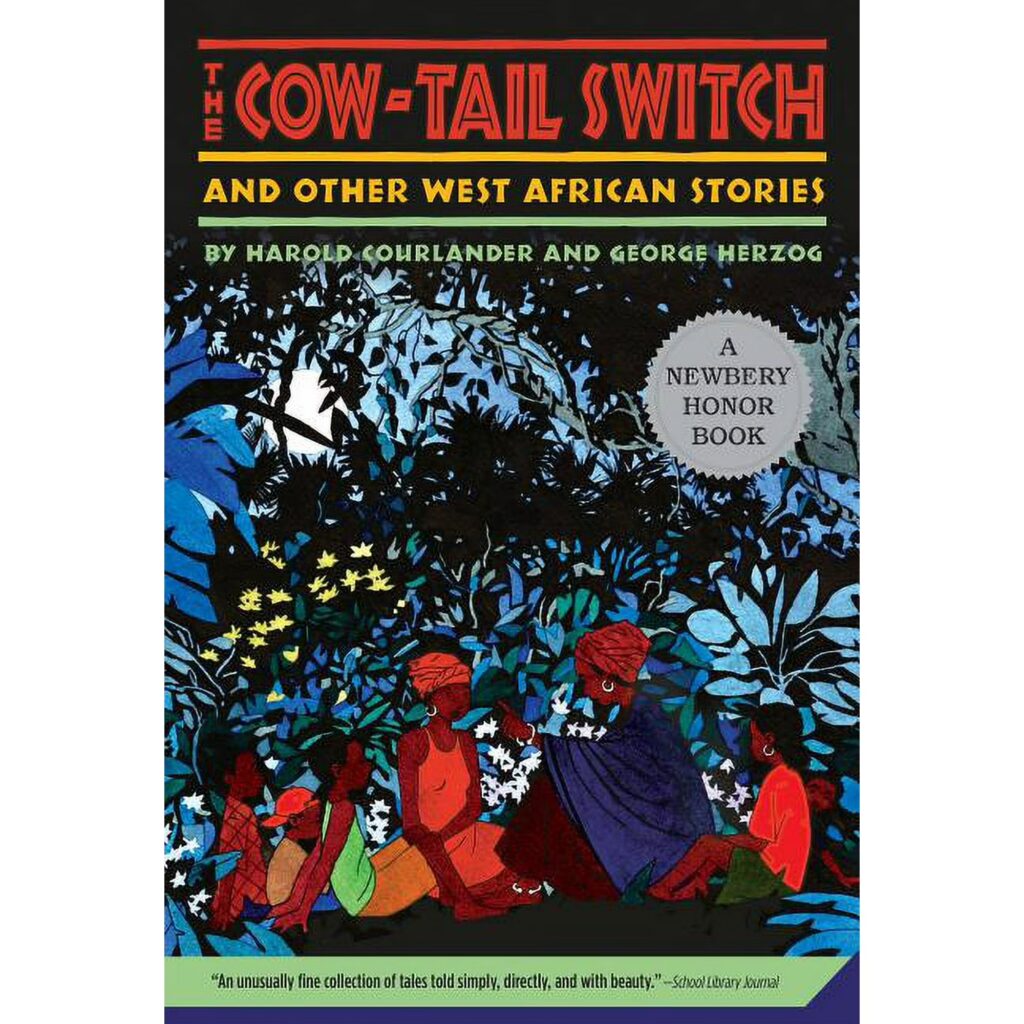
The Cow-Tail Switch as Story Learning Device by Liz Warren

What are the elements of a story, and how can a folktale help us learn and remember them?

One answer is hiding in plain sight in the well-known and often told Liberian story, “The Cow-tail Switch.” It serves as the title story of a collection curated by Harold Courlander and George Herzog which received a Newbury Honor in 1947. 

The story tells of a great hunter who goes out to hunt one day and never returns. A few months later his last child is born. The baby boy’s first words are, “Where is my father?” None of his five older brothers has an answer. He asks and asks until finally the brothers agree to look for their father. One remembers seeing the path he took into the forest, and they head that way. They find his spear next to a pile of bones. The older brothers, who are all magicians, proceed to reanimate him. One by one they put his bones together, add his flesh and blood, and give him movement and breath. They all return to the village, and the father announces he will give the prize of a cow-tail switch to the one who did the most to bring him back. Of course, each of the older brothers says his own contribution was most significant. But the father gives the switch to the youngest, as it was he who insisted that the story of what happened to him be discovered. “A man is never truly dead until he is forgotten,” says the father.

The process the magicians used to rebuild their father contains all the elements an oral story needs to be effective. They also give us a good sequence for building or learning a story we want to tell.

Bones = Story structure

What is essential to understanding the story? How is the story organized to document what changes? How does it proceed from beginning, middle, and to the end? If you had to describe the story in a sentence or two, what would you say?

Flesh = Senses

What do you see, feel, touch, taste, smell, or hear in the story? What temperatures and textures, what scale and substance? What must your listeners feel (in a sensory way) to understand the story?

Blood = Emotion

What are the dominant emotions in the story? Do they change as the story proceeds? What is the emotional tone at the beginning, middle, and end of the story? How do you feel about the story, and what do you hope your listeners feel?

Movement = Gestures and physical expression

How will you embody the story? Where in your body do you feel it? Do the people in the story move in ways that you can incorporate into your telling? What facial expressions can you utilize to engage your listeners in the emotions of the story?

Breath = Speech

What words will ride your own breath to convey the sequence and meaning of the story? When will you speak in the voices of the characters? When will you speak as the teller of the story? How will you use pace and tone to convey the action of the story or the personalities of the characters?

As in the story, it all starts with what the youngest brother gave – intent. He insisted that the story of what happened to the father be discovered. His relentless curiosity and desire to know the story motivated his brothers, which resulted in his father’s rebirth.

Just as a man is never truly dead until he is forgotten, so too can we resurrect and tell stories that may be waiting in books, in the land, and in family and cultural memory.  Our desire and commitment to give the stories life is the key.

You can read Courlander and Herzog’s version here and Heather Forest’s version here.

6 responses to “The Cow-Tail Switch as Story Learning Device by Liz Warren”

  1. Amy Avatar
    Amy

    This is a great way to visualize the process of learning a story to tell. One of the greatest anxieties for new tellers is learning the story – this is a great tool to help alleviate this anxiety.

  2. Diana Apresa Avatar
    Diana Apresa

    First time I hear this story and will remember it for sure. It definitely embodies the elements of a story. I really like how you explained it with a story rather than a plain description. this helped me create a more powerful meaning to remember the parts of a story. Thank you

  3. Elonda Avatar
    Elonda

    It was and is a great story. It caused me to reflect, pause, ponder, and triggered senses of imagination meeting reality; It cultivated the wisdom of life, humanity, and genuine heart where I feel stories began.

  4. Lisa Marie Avatar
    Lisa Marie

    This is a very useful reminder of the layers that go into a good story. The Bones, Flesh, Blood, Movement and Intent are all part of what brings a story to life. Most people only think of the words-
    Structure, Senses, Emotions, Expressions, and Speech are all layers in the process. We see and learn and experience stories on multiple levels as a listener (and as a teller).
    Especially interesting, is the differences between Senses and Emotions; they are closely related but not the same.
    Structure and Speech are in the crafting of the story-
    as we see vastly different versions between Heather Forest and Courlander/Herzog. Both are well told versions, and could be useful in different settings, for different audiences.
    Lastly, the physical embodiment of the story, and how it is carried by the teller, by expression and gesture, is often a subconscious reaction if not addressed directly in the crafting of the story. I myself could use some direct focus on this particular point when preparing a story- and becoming the story. Thank you for this helpful example in story form!

  5. Diana Bejarano Figueroa Avatar
    Diana Bejarano Figueroa

    This is such a good way to teach us about the elements of a story.

    I really like the part: “A man is never truly dead until he is forgotten,” says the father.

    I feel like many cultures have beliefs about those who have passed and how we need to remember them, like in the movie/story Coco with the song Remember Me…during Dia de los Muertos.

    I like how you compare the Bones ot the Story structure.

    Flesh = Senses is about bringing the father and the story to life.

    Blood brings out our Emotions. First we feel sad that the father never returned, then that he was dead and then we get new happier emotions to find out that the magician bros can bring him back to life again for the younger baby son.

    Movement = Gestures and physical expression

    You have to feel the emotions when you tell a story to connect to the audience.

    Breath = Speech

    How you use your breath and speech dictates the feeling of the story just as much as the words you choose.

    Love this: Just as a man is never truly dead until he is forgotten, so too can we resurrect and tell stories that may be waiting in books, in the land, and in family and cultural memory. Our desire and commitment to give the stories life is the key.

  6. Patricia Blaisdell Avatar
    Patricia Blaisdell

    WOW, this blog gives us so much material to construct our stories. I found it useful in organizing my story and how to put it together and gives real context on how to move forward.

Leave a Reply

Your email address will not be published. Required fields are marked *