The thing that distinguishes stories from other narrative forms is that stories hinge on change and transformation. Stories document change. Things are always different at the end of the story than they were at the beginning. That might include anything from a dramatic life-altering event, a challenge that got resolved, or an “aha” moment that brought a needed change in perspective.
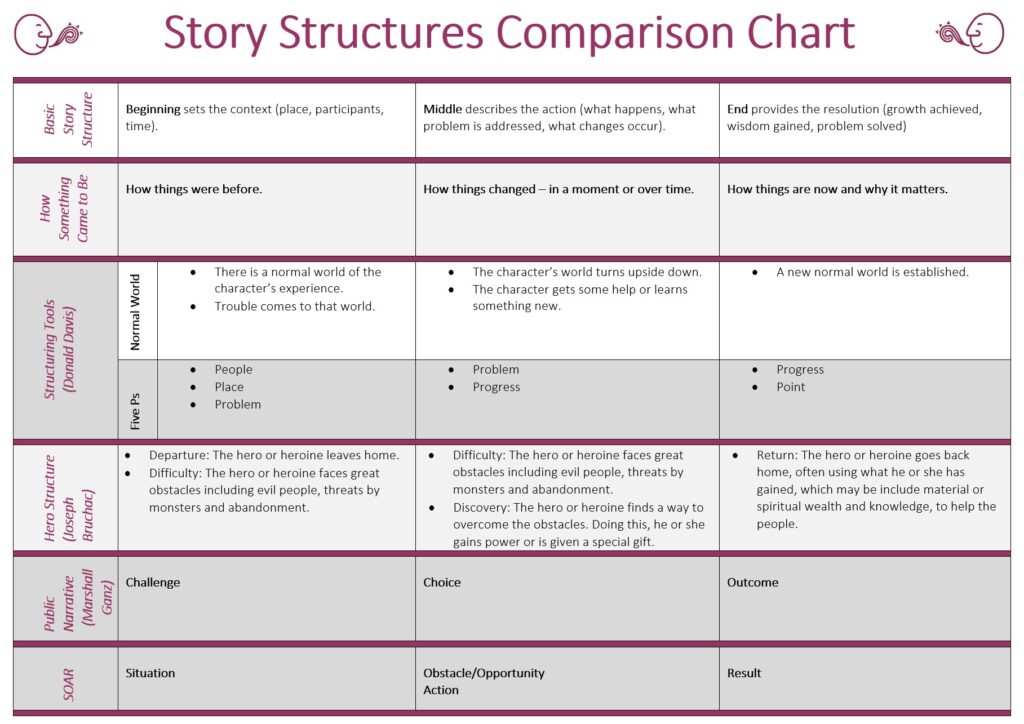
The chart below provides several simple story structuring devices, and builds on the time-honored beginning, middle, and end framework we learned in elementary school.
In the first column, the beginning sets the context. Where are we, who are we with, when in time?
The second column, the middle, describes the issue that disrupts the beginning, and might also include how that disruption is addressed.
The end, in the third column, might include the solution, or it might be where the teller reflects on the meaning or significance of the change, or both.
When you are building a story from a memory, choose a horizontal line and think it through. For example, if you choose “How Something Came to Be,” you would:
- Describe your situation before and up to the moment of the story:
- When I was 6 years old, and before everyone had cell phones, my parents let me fly by myself to spend time with my grandparents in Washington DC. The flight attendant was very watchful, and I wasn’t scared. Just excited.
- Then, describe the issue, challenge, or whatever changed things:
- We arrived at Dulles airport, and the flight attendant took me into the terminal to find my grandparents, but they weren’t there! Announcements were made throughout the terminal, and I was taken into a little lounge and given a soft-drink and a snack. After an hour or so, we learned that my grandparents had gone to Ronald Reagan airport and were frantically searching for me there.
- Wrap up with how the issue was resolved and what it meant:
- After another hour, they came rushing in with apologies and relief. But I was fine, and more importantly, even at that young age, I realized that I could manage something unexpected.
You might find that the Five Ps works better for your story, or the hero’s journey. The central insight of the chart is that whichever structure you choose, they are all doing pretty much the same thing.
Here are some additional strategies often used by storytellers that still incorporate the essential job of a story – to document change.
- Framing or Nesting:
- Starting with one story, transitioning to a related story, closing with a return to the original story and how they relate, enhance and deepen meaning, show a pattern, etc.
- String of Pearls:
- Set a theme at the beginning of the story by telling an anecdote or a short story, or by actually stating the theme or central idea of the story.
- Tell multiple (usually three) shorter anecdotes (the pearls) that illustrate the theme.
- Wrap up with something that deepens/enhances the meaning.
- In Medias Res – Starting in the middle:
- Start the story at the most significant or dramatic moment.
- Transition back to the normal world, People + Place + Time.
- Bring us back to the dramatic moment.
- Tell what happened after and why it matters.
What’s the difference between an anecdote and a story?
- An anecdote usually corresponds to the Problem, the moment that the Trouble came.
- A story gives the full context. It documents the change that resulted from the events described in the anecdote.
Leave a Reply