A tale should be judicious, clear, succinct;
The language plain, the incidents well link’d;
Tell not as new what everybody knows,
And, new or old, still hasten to a close;
There, cent’ring in a focus round and neat,
Let all your rays of information meet.
What neither yields us profit nor delight
Is like a nurse’s lullaby at night;
From William Cowper’s “Conversation”, 1782
 On the evening of Friday, June 22, Liz Weir and I drove from Cushendall to Moy. The reason that we were in Moy, or The Moy as the locals say, was so that we could attend an evening of storytelling and music at The Eagle Bar featuring Liz’s storytelling students.
During the spring, the students had all participated in a program called Tall Tales and Short Stories, hosted by the Rural College in Draperstown. Liz said that working with them was one of the most satisfying teaching experiences of her life. The program was coordinated by Roisin Kelly, who said about it, “We have run storytelling events in the past at the College but never one on such a scale and this all fits our ambitions to help keep rural community traditions, such as storytelling, alive. It’s easy, in the face of changing lifestyle patterns, and amid our public’s constant demands for convenience and technology, to lose the old skills such as storytelling which have shaped who we are today. In this respect it’s wonderful to be able to equip another 29 people with the skills and confidences to entertain far and wide. Indeed, the ‘Tall Tales and Short Stories’ experience has shown how storytelling can cross the barriers of age, culture and disability.”
 About half of the class showed for this evening at The Eagle including Joe Doherty, Malachy Gribben, Anthony McBride, Hugo McOscar, Sean Toner and Pat Mulkeen, all of whom performed. Joe Doherty and his friend Will Gribben were amongst the first to arrive. Since it was still quiet in the bar, Liz asked him to recite the poem at the beginning of the post, since it is as good a set of instructions for storytellers as any of us are likely to find anywhere. Later, Joe asked me if I knew Oliver Goldsmith’s story about the donkey. When I said I didn’t, he proceeded to tell me the very donkey story I’d been searching for on the web the previous day, except his version was much better. In this version when the man and his son decide to carry the mule as someone has suggested to them, they first tie his hooves together. As they are walking over a bridge with the donkey on their backs, the donkey spooks, thrashes, and falls into the water. Since his hooves are tied, he can’t get out of the water and drowns before the two can reach him. Then the father says to the son, “Do you see what happens when you try to please other people? You please no one and you lose your ass in the bargain!” The best part was that I’d said nothing to Joe about the donkey festival or my interest in that story, and that was the one he chose to tell.
Liz was justifiably proud of her crowd. Some had performing backgrounds, but others were brand new to storytelling. Pat Mulkeen is a playwright with a theater background and when she got up to tell her story her stage presence was magnetic – every eye in the pub was riveted on her. Anthony McBride and his cousin Hugo McOscar are both musicians. Anthony is booked every weekend and when he got up to perform it was easy to see why. He sang and told a version of the mirror story, which I’ll tell you about later, that I’d never heard before. Hugo is experimenting, successfully, with creating stories to frame classic songs. “I’ll Take You Home Again Kathleen” was the one he told and sang that night. The new tellers were very good too. Sean Toner told a hilarious story about crashing his car into the Royal Ulster Constabulary station on a Christmas Eve in the ‘80s, after losing control on the ice. Amongst other great lines, he said the officers in the station thought he was a suicide bomber and suicide bombers hadn’t even been invented yet!
Much of the humor and the tension in Sean’s story relied on the audience’s experience with and understanding of the conflict between Protestants and Catholics, the Protestants being represented by the RUC and the Catholics by Sean in his story. The conflict and its consequences permeate all aspects of life in Northern Ireland. Royalists, who are usually Protestants, if they want to make their politics clear, paint their curbs red, blue, and white; Nationalists, who are usually Catholics, would paint theirs orange, green, and white. Towns, or neighborhoods, with predominantly Unionist sympathies will spread red, blue and white bunting across the streets and paint murals of the queen. The bunting is put up during the marching season from Easter to September, and especially around July 12th when Protestants celebrate the English victory at the Battle of the Boyne in 1690 with bonfires and parades through Catholic neighborhoods.
These public, provocative, displays are the proverbial tip of the iceberg, however, since there is a great mass of cultural habits and nuances that people in Northern Ireland constantly negotiate in everyday life. Malachy Gribbin told a story in which a man’s identity was in question. One character said to another, “Tell me. Would this man’s funeral be held at ten o’clock or at two o’clock?” The answer would reveal whether the man was Protestant or Catholic, since each holds funerals at a particular time of day. This is where my own lack of cultural knowledge becomes apparent, since I don’t know which one has the morning or which the afternoon. But the audience did and everyone laughed.
Liz had said that Roisin would be serving sandwiches at 10:30, which astonished me. Who would want to eat that late? The sandwiches didn’t actually arrive until 11:30, at which point I ordered a Guinness and tucked in eagerly with everyone else. When in Moy . . .
It was getting late and I was beginning to get anxious about logging enough sleep for the busy day to follow. Liz and I left about 1:30 a.m. Anthony McBride gave us a ride back to the hotel. We fell into bed, only to be awakened about 2:30 by the sound of an apparent riot in the street below. We both jumped up and went to the window where there were at least 60 people milling about aggressively. It looked like a colony of angry insects and it sounded like something was about to erupt. The noise went on until close to 3:00 and all I could think of was how am I going to function telling stories from noon until 11:00 p.m. on four or five hours of sleep? But then I had some sort of epiphany – somehow I realized that I’d be fine, that all would go well. And sure enough it did.
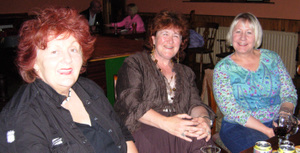
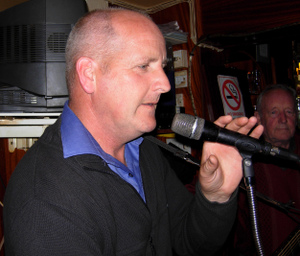
The first picture is Pat Mulkeen, Liz Weir, and me. The second is Anthony McBride.


Leave a Reply