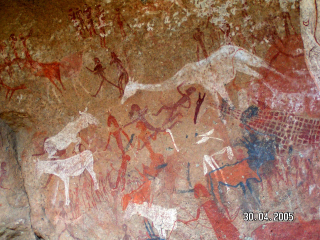
 We’ve all been brainwashed to accept that efficient agriculture allowed social specialization and hierarchy to occur, which led to “civilization;” the best there is. “Civilization” has also led to overpopulation, a horribly MAN-ipulated ecosystem, and a hurting Mother Earth. Maybe we should have stayed hunter/gatherers, small groups of co-responsible, eco-sustainable folks, where everybody knew your name.
For some idea of what that pre-sedentary, pre-agriculture world was like, we can look within traditional tales of West and Central Africa, to a genre of stories called Hunter’s Narratives, stories—often with songs, too—about people with skills passed down since before we had farms; stories of people who could brave the chaotic, untamed, Spirit-filled Natural world, kill something, and return home, uncursed. The Hunter, who moves between the world of the Wild, and the Civilized, must manage, mediate and mitigate huge amounts of spiritual power, set loose when any living thing is killed.
The Mongo Cycle of Lianja of central Zaire, and the Buffalo of Do episode of the Sundiata Epic of the Mande of West Africa, are examples of these “throwbacks” to pre-agricultural society: Hunter’s tales.
Steven Belcher (2009) finds three key features of the genre of Hunters’ Narratives: the “magicality” of the hunter; their ability to transcend normal reality/society; and the story’s portrayal of where the hunter stands in relationship to normal society—which is always a bit outside it, for the hunter has special, abnormal powers.
In these stories, the hunter, pitted against a fantastic beast, already in the midst of a killing spree, does not always win. In these stories, “conjugal relations” often enter, as does the appearance of “animal women,” changelings who come to seduce the hunter. Wow; what’s more Life-and-Death than that?
Belcher’s “Three Key Points” of the Hunter’s Story ring true for the African American hero ballads I have been collecting and studying! These tale-songs: Stagger Lee, Lost John, Railroad Bill, Shine, Betty and Dupree, Frankie and Albert, Duncan and Brady, Casey Jones, the Traveling Coon, Mysterious Coon—created by the first generation of Blacks born outside Slavery, all match Belcher’s criteria. There’s “something special” about the characters; they act beyond the bounds of normal culture; the story shows the outcomes of living “outside the lines”.
As Hunter’s Narratives teach the balance the Hunter must keep between the Civilized and Wild World, these AfrAm tales document Post-Bellum Black culture creating its own definition of man—and woman-hood—outside the Wildness of the institution of slavery, in the new, free civilization they were carving for themselves, through the time of Reconstruction and beyond.
Too soon, these songs passed into EurAm and consumerist culture, and were warped—stories of magical pride and power degraded into buffoonery. Concurrently, Coon Songs appeared, “counter measures” against assertions of positive AfrAm culture.
The same backlash occurred a century later, in the 1990s, when the first generation of children raised in a “de-segregated” U.S. created a new art form: Hip Hop. Early Hip Hop had a huge Afrocentric, positive component, until it, too, was co-opted by mass media/EurAm culture. Stories of “Rise Up” turned into East Coast/West Coast rivalry, and images designed to fit the old “thieving,” gangsta,” misogynist stereotypes flooded the market.
Within these ancient African tales, within these 19th century ballads, within KRS-One and Tribe Called Quest, are clues, keys to a different way of seeing the world, where Black Lives Empower, mediate the wilderness, and secure society—from partially outside it—and change the world.
(The image at the top of rock art from Namibia can be found here.)
Leave a Reply