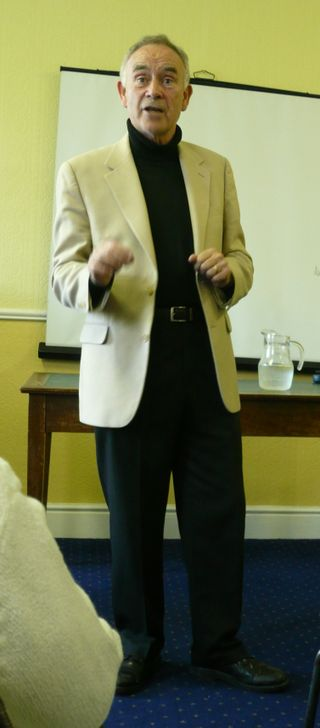
 The Dublin Yarnspinners is held the first Thursday of every month at 8:00 p.m. in the Club na Múinteoirí, the Teachers Club, at 36 Parnell Square. This month’s session was on the top floor, and when the participants of Study Abroad Ireland arrived we found Aideen McBride at the door and her father Jack Sheehan inside visiting. Jack Lynch was there, too, talking with the featured teller for the evening, Batt Burns.
I hadn’t heard Batt Burns since the first time I came to Ireland in 1996. Mark and I came on a storyteller’s tour of Ireland that was organized by Don Dole and Marlene Rausch. We spent our first two nights in Sneem, where Batt and his wife live.
I introduced myself to Batt and said I’d met thirteen years earlier on a tour. He paused for barely a second and said, “Was it the Doyle group”? Later he told the audience that we’d kept him up the whole night singing, playing music, and telling stories. He had, in fact, organized a ceili for us at his house all those years ago.
I’d heard criticisms of Batt over the years that he was an Éamon Kelly knock-off, albeit a very good one. But we didn’t get a knock-off on Thursday night. We had a great night of stories, poems, and bits of lore to fill in the cracks from a man who knows how to capture and hold the attention of his listeners.
All but a couple of the Study Abroad Ireland students came, plus the faculty, and another twenty of the Yarnspinners regulars. The Americans were all sitting together on one side of the room, and the Irish filled in the other side and along the back wall.
Jack Lynch introduced Batt, who welcomed us and started off with a poem by Sigerson Clifford called “I am Kerry”. Clifford died on January 1, 1985 and I almost raised my hand to say, “Hey, I got married that day”! The poem is apt because Batt is a Kerry man and his stories are rooted in that landscape and ethos. The one line I caught was, “They didn’t come to admire me when I was worth looking at”.
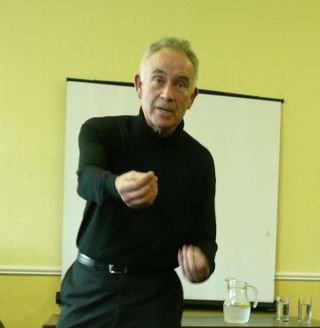 Batt then told us of one of the greatest influences on him as a person and as a teller. His grandfather, Michael Clifford, was “an old time seanchai”. Batt spent years of his childhood with his grandfather who would tell stories from Samhain (October 31) through March, just as do Native Americans and farming people everywhere. On Bealtaine (May 1), Mr. Clifford would cut branches of oak, elder, and ash and place them all around inside the house – on the mantle, over the picture frames, and doors. When young Batt asked him what he was doing, he said, “I’m bringing in the summer”.
Batt told us that he didn’t like his grandmother because it was she who would send him to bed before he was done listening to his grandfather’s stories. He often crept back out to the top of the stairs as Mr. Clifford continued on with stories and lore for the neighbors and friends.
To evoke his grandfather’s style, Batt pulled on an old cap and put a pipe in his hands. He told a story his grandfather had told about a Protestant minister who had a fine church, but no congregation and no wife. The priest told him about a man who had “a fine lump of a daughter”. The minister was intrigued, and when he met her so captivated, that he accepted Catholicism. The only problem was the prohibition against meat on Friday. The story ends with the minister finding a way to have his meat and eat it too.
That was the only story Batt told in character. He next recited a beautiful poem by Brendan Kennelly after telling us a little about the poet and scholar, who is a Kerry man. The poem is “The Story”, and it is one I must learn. It is about what happens to a community when the storyteller and the story pass on. In short, “The people withered”.
Next he told a story about Moll the Whalloper, a woman “who had a mighty grip on money”. She was “as tight as a crab’s arse, and that’s water tight!” Moll doesn’t want to pay to license her dog, pretends the dog has died, but is eventually found out. She is, of course, found out in a most humorous way.
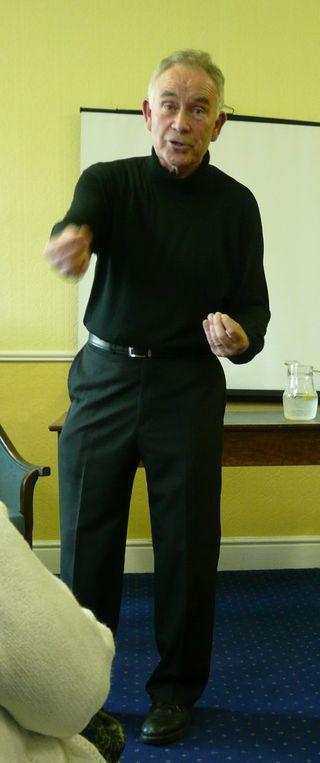 Batt then told us about the writer Brian McMahon. From McMahon he learned that when a male idea and female idea come together a story comes out. He described for us the various streams of ideas that had come together for him in an original story set at the Giant’s Causeway. The story integrates several familiar motifs, but ultimately plays on the type of “the one-wish”. I won’t give his story away, but in Liz Weir’s version a poor man with no children and a blind mother wishes, “I wish my mother could see my wife rocking our son in a golden cradle”.
After a twenty-minute break “for tea and soda” (the Teachers Club has a full bar on the second floor), Jack Lynch welcomed us back, made some announcements, and made me laugh. He was describing some Irish musicians who had played for the Dalai Lama and “his feet were seen to be tapping”. He told us about a man who had been watching a group of women practice tai-chi at a retreat center for an entire week as he rested his arms on a stone wall. The man never said a word until the last day. As the women held their poses he was heard to utter, “Shteady, girls! Shteady”! I know this is not as funny, or maybe not funny at all written down here, but in person it was very funny. You had to be there.
Jack then told Peig Sayers’ version of “Butterfly Soul”. I’ve never seen that version and I’d really like to. Jack said that Miceál Ross told him the story was first written down in France in the 8th century and probably came there from Greece, since the Greek words for soul and butterfly are both “psyche”.
We had four stories from the floor, including a piece from me, “The Giveaway”, a poem about St. Brigid by Phyllis McGinley. I also told them about the Three Rivers Storytelling Festival, and its culminating concert featuring Jack Lynch and Liz Weir on Thursday, June 18, at the Prince of Wales Hotel in Athlone.
Batt finished off the evening. He told us “there’s no mystique to storytelling”. The trick, he says, is to utilize “the natural techniques of living to bring a story to life”. He then told us a marvelous version of “The Man Who Had No Story”. Click here for different version. The evening had started at 8:00 and the stories were over at 10:50 p.m.
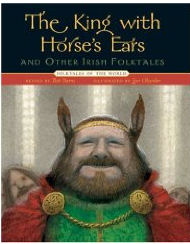 Batt has a brand new book out, The King with Horse’s Ears. He had a big box with him and most of the Study Abroad Ireland participants, including me, bought one.


Leave a Reply