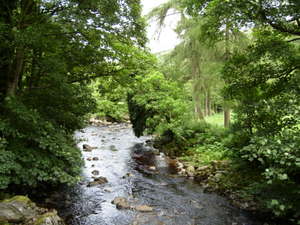
 One day a young woman came upon an old woman washing a stack of tiny white shirts in a river in the north-east corner of Ireland. When she inquired about the shirts the old woman told her, “These are the fairy’s war shirts. There will be a great battle in Scotland tomorrow between the Scottish fairies and the Irish fairies, and these are the shirts the Irish fairies must wear.” The young woman asked, “How will we know the outcome of the battle?” The old woman replied, “If the Irish fairies win, the water in this river will continue to run clean and clear. If the Scottish fairies win, the river will run brown with the Irish fairies’ blood.” The next day when the young woman came to the river it was running brown, and she knew the Irish fairies had lost. That’s why the river is called Dun, or brown, and also why the fairies are gone from that part of Ireland.
 This is just one of the many stories that I heard from Liz Weir as we traveled from Athlone to her home in Cushendall on Thursday, and then around the spectacular Glens of Antrim on Friday, June 21st and 22nd. We left Athlone mid-afternoon after Liz had done three sessions for Mary Dillon at the Ballinasloe Public Library. We got to her home, the Ballyeamon Camping Barn, about 8:00 p.m. where we were met by Eric Linsker who is back again for a second summer as barn minder. Eric has just finished his B.A. in poetry at Harvard, and after serving as barn minder will be studying in Paris before heading of to the Iowa Writers’ Workshop.
The camping barn is about five miles from the coastal village of Cushendall, which means “the foot of the Dall,” and that’s where we went for a great steak dinner at Harry’s. Then we walked across the street to J.W. McCollam’s, better known as Johnny Joe’s, a pub famous for its traditional music and good craic. We met up there with the people who were staying at the camping barn that evening, an American and British couple who had spent the previous year teaching English in Korea.
It was the summer solstice, the shortest night of the year, and at that latitude it is short indeed. I was sleeping in Liz’s daughter’s room and I woke up about 4:00 a.m. to an awareness of greenness filling the room. The window in the room faces west, but somehow the dawn light was illuminating the foliage on the hill outside it, making the window and room glow like a living emerald.
That morning Liz completed a grant proposal that had to be delivered that afternoon and I checked email and thought through what I would be telling at the festival the next day. I was scheduled for three sessions for children, plus a couple of stories in the evening concert. Since the storytelling festival coincided this year with a donkey festival, I tracked down the Mulla Nasruddin story about the man and his son who are taking a donkey to market. In response to suggestions and criticism from the people they pass along the way sometimes the man rides, sometimes the son, sometimes both, but ultimately they carry the donkey into the town on their backs.
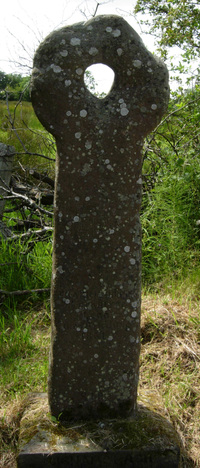
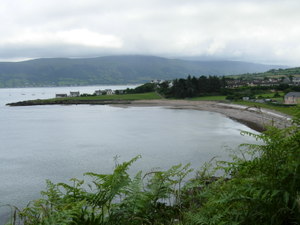 Liz had an appointment in Cushendall at 1:00 p.m. and we agreed to meet at Arthur’s for lunch at 2:15 p.m. I shopped for music for Mark at Celtic Crafts and then walked along the cliff path above the beach. After lunch, Liz took me to the ruins of the Layde Church, established in 1306 when it replaced an even older one, and with a stunningly picturesque view out to the sea. One of the most interesting monuments there was what I think Liz called a trothing stone, called a “holed cross” on various websites that describe the site. It is generally considered to be much older, perhaps pre-Christian and there is a story of tragic young lovers associated with it.
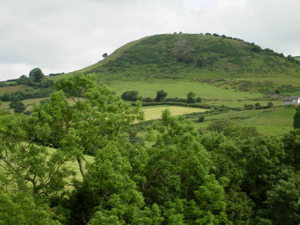 We then drove to Cushendun, “the foot of Dun”, the town associated with the story at the beginning of the post. Liz’s friend Feargal Lynn manages a nursing home there and when we arrived he was in the entry way, right in the thick of things as attendants and residents went about their business. Feargal brought us tea and cake as we visited with Jamie O’Rawe, born in America to Irish parents who came home to run the family farm, which Jamie then farmed himself. A musician all his life, Jamie told us that he had spent several hours the previous night listening to tapes of himself and others playing. There is a fairy hill called Tieverah in Cushendall and Liz asked Jamie if he would have ever walked on it. “Oh, yes,” he said, “We’d walk around that hill any time.” The confidence of his response almost diverted me from the fact that he’d said “around”, not “on.”
Liz then took the long way home, up through Glendun, over a high place that led us to Glenballyeamon and back to the camping barn. Along the way we saw graveyards, bridges, bog cotton, sheep, and gorgeous vistas at every turn.
We had a little over an hour to get ready to head down to Moy, south-west of Belfast for the evening’s events.
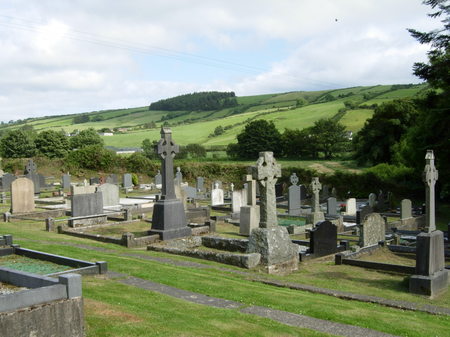 Pictures from the top: The Cushendun River, the trothing stone, Cushendall Bay, Tieverah, and a graveyard outside of Cushendun.


Leave a Reply