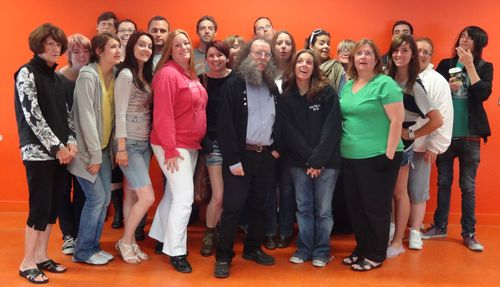
Eddie Lenihan visited The Irish Storytelling Tradition on the morning of Thursday, June 16. I had intended for his book, Meeting the Other Crowd, to be our text but not all the students could get it since it’s recently gone out of print. Eddie started out by telling us a little about the book, which is composed entirely of stories of the fairies, “the good people” or “the other crowd”, that he collected from “the oldest of the old” people living in the west of Ireland. “I check these places out myself and the landscape matches exactly what the person was talking about. The only thing I did with that book was I chopped down the voice; otherwise it would have been boring. I had to cut them down to keep people from going to sleep”. Below are the stories Eddie told us along with their number in our long count.
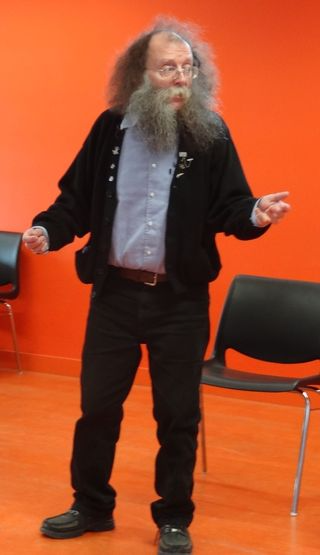 1. (74) Eddie started off with one of my favorite stories from his book, “Refereeing a Fairy Hurling Match.” He told us it was from Limerick and would normally have been for children. It’s about a man who is coming home late from playing cards. He is stopped in the road by a small man, one of “them”, who asks him to referee their hurling match. Of course he knew, since he’d been asked directly, that he had to do it. “Cooperate with the lads if you ever met them. They’re like us in every way, except one, they need a human being to do things properly. If you cooperate they are likely to reward you.” He was led behind a bush in a gap in the fence and there was the field and a fairy fort beyond it. There were no goal posts, just hawthorn bushes on either end of the field. He started the game and it was “just like a faction fight. The two teams of fairies were snarling at each other like two packs of wild dogs. They were small but they were ferocious. Goal for goal and point for point.” The human referee engineers it so that the game ends in a tie, which pleases the fairies. They tell him, “That’s’ the best game we’ve had and we’ve been coming here for the last three hundred years.”
2. (75) To introduce his next story, Eddie told us the Christian legend of the spider. “Don’t harm a spider. Christ was on the run as a baby from the Roman soldiers. A spider came and wove its web over the cave where Mary and Joseph were hiding. The soldiers saw it and thought no one was there. So, leave a spider be it’s a sacred animal because of that.”
3. (76) The spider story was just part of the introduction for his next story which was about a weasel. He’s working on a book about them. He told us that the Vikings brought both the weasels (the Danes cats) and foxes (the Danes dogs) to Ireland. Weasels are “Intelligent and dangerous. They have teeth like needles and corner a weasel and it behaves like a cat – the fur goes up and it will spit. Even a big dog will not attack a weasel, because the weasel will go for the throat.” The story was about a man near Liscannor when times were hard and good food was not always plentiful. He sees a weasel with a rabbit and manages to get him to drop it. But then the weasel followed him almost all the way home. Finally, the man remembers something that his grandfather told him. “Weasels are uncanny and dangerous. If you steal anything from a weasel you’re making a mighty big mistake. You can lock the doors. You can lock the windows, but you’ll be found dead in the bed in the morning.” The man gave up and threw the rabbit back.
4. (77) Another story about weasels that a man told him as they waited in the doctor’s office. It happened near Shannon. Small fields there and throughout Ireland have names and histories. And yet they are heartlessly bulldozed by “developers”. This man bought several old fields. He was warned about two of them by the old man he bought them from but he ignored him. He bulldozed the old stone walls and made one large field. But once the sheep came and the lambs were born, the next morning every one was dead. The old man had been trying to warn him about the weasels’ nests. “They weren’t going to be disturbed. You can’t talk to people whose only god is money and unfortunately in Ireland we’ve got more of these people.”
5. (78) Eddie’s next story was a remarkable one about an abandoned house, well made, that been a shop in the1880s. In brief, there was young priest who in response to an insult cursed the structure with cats. The cats overtook and destroyed the business. Eventually the bishop after a very stern lecture to the young priest on his abuse of powers, managed through “pure dint and fierce effort” to confine the cats to the basement. He locked them in and told the owners if they ever opened the door he couldn’t be held responsible for what happened. But no one thereafter could ever live in that house. Eddie checked it out, and although there may have been other reasons besides haunted cats in the basement, the structure had been bought and sold restored and then abandoned more than once. Eddie then gave us a postscript to the story. He met an old man who was coming home from the pub after a couple of pints. He was walking along and saw that the house, there on the other side of the road from him, was being reconstructed again. “The door saddle wasn’t in yet, so there was a gap below the bottom of the door. His eye caught a movement. He looked and saw something he’d never seen before. There walking down the other footpath, was a line, a little convoy of cats head to tail, head to tail, at least 12 of them. He stood there watching them stupidly. One after the other, in under the door with only an inch gap at most. He wasn’t drunk, but he got home fast that night. He knew the reputation of that place.” Eddie told us that he had no doubt that the man believed what he was saying. “This is the difference between reading a book and looking at a person’s face. That person was telling me something that frightened him of a night. He’s not telling a lie. That’s interesting in itself.”
6. (79) Eddie’s last story was about Biddy Early, about whom he has also written. She lived in Feakle in east Clare, where there is “no plaque to Biddy Early, or gravestone, and she one of the most famous people in Ireland and yet Feakle is afraid of her.” She was married four times, in trouble with clergy, and with the police who accused her of running a shebeen. She was a “woman ahead of her time, a healer, a herb doctor.” The story is the one about Biddy and the priest’s horse, in which she gets revenge for slanderous remarks he made about her from the pulpit. And yet,” Biddy and the same young man became the best of friends afterwards.” Eddie told us that Biddy would never ask for payment, yet people would bring her what they could, and that was often a bottle of poitín. Three or four months after Biddy died an “avalanche of empty poitín bottles” was found behind her house, which fueled the speculation that she had been running a shebeen. But Eddie says that wasn’t the case. The bottles may have been drunk there, but Biddy wouldn’t have been selling alcohol.
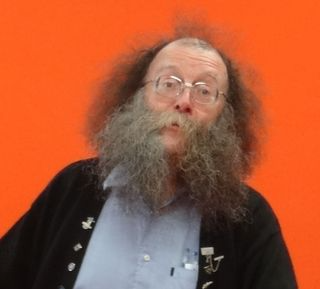 Eddie ended by telling us some of his motivation for doing what he does. He first got into in when he was doing his M.A in Phonetics. He was initially collecting for the language, but soon got interested in the stories themselves. He said, “I was sick and tired or reading bits and pieces of scraps by Anglo-Irish writers like Yeats and Lady Gregory”. He told us that he knew people from around Gort, Lady Gregory’s area, where she was collecting stories. “She was a different class entirely, so they were always that bit afraid or suspicious. It was never an even playing field. They gave her what she wanted. And, I’m not so sure had Lady Gregory Irish”. So what quality of stories did she actually get? He wanted to collect the fairy stories from an ordinary person’s point of view. “Who are they, where do they live, and if you meet them what do you do.” He couldn’t find it, so he collected the lore and wrote the book as a start. “If you wanted to be bitter in Ireland it would be very easy to. It’s better to get on with your job and do it.”


Leave a Reply