“You should take storytelling.”
Storytelling?! My face probably said it all: perplexed, confused, maybe even a little skeptical.
“Yes, storytelling,” the advisor repeated, as if it were the most obvious thing in the world.
“Sounds freaking whack,” I thought.
But after what felt like an eternity of debating with myself, I said, “Ok, sure… let’s do it.”
Most of my reluctance? Ego. About 90% of me thought I was too cool, and the other 10% was me convincing myself that I was most definitely too cool. In the end, I ultimately said something that rhymes with “Duck it,” and just went for it.
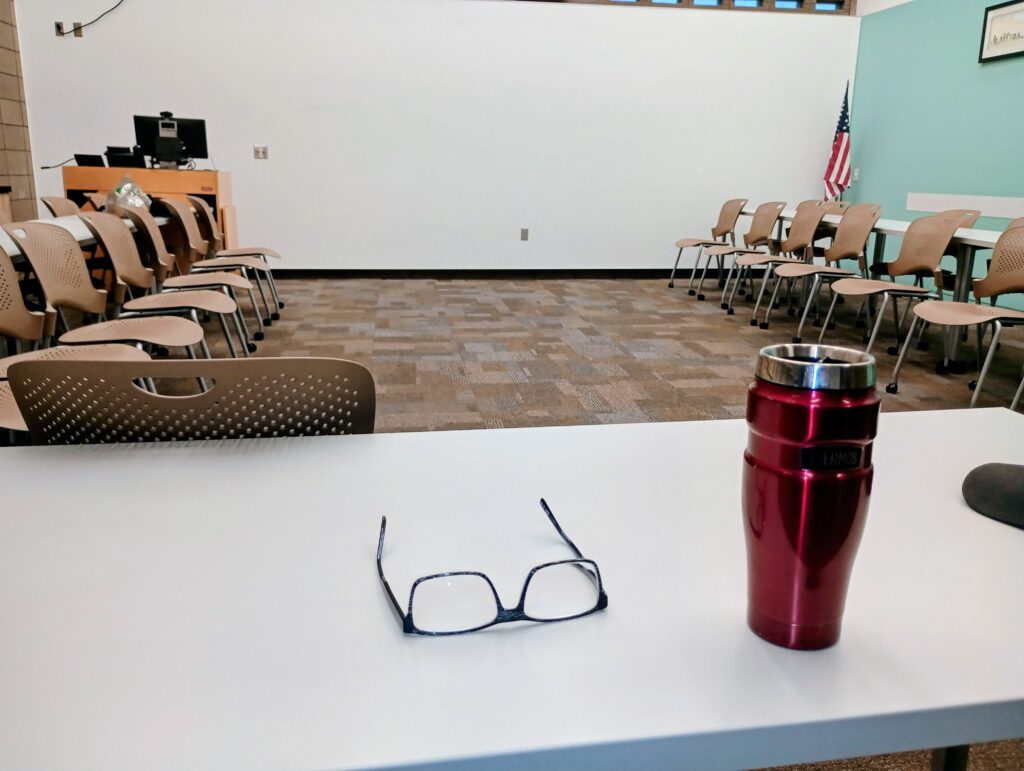
I walked into class all cool and tough-looking, ready to conquer, or so I thought. That’s when I realized I would be facing my old arch-nemesis: public speaking.
And, if that wasn’t enough, here came the sidekick nobody warned me about: homework. Homework didn’t just lurk in this class; it was everywhere. I could run from public speaking, but homework? It followed me like a shadow, ready to strike. Public speaking might have been confined to this one class, but homework stalked me, tormenting me at every turn. Homework wasn’t going away quietly. I found myself sneaking in last-minute assignments while obsessing over lines of my story. My brain ran wild with “what-ifs” at 2 a.m.
Even so, the few battles I had with public speaking weren’t as intense as our past encounters, but the days leading up to them were. Brutal. My mind was racing: Did I have the story right? Would I forget everything? What if everyone laughed? What if my voice shook too much? Every scenario played on repeat in my head. I spent hours imagining every disaster, overthinking every tiny detail, trying to plan for every possible outcome. Basically, I turned myself into my own villain
Luckily, I had a secret weapon: a picture storyboard. I learned this technique from Liz Warren, a master storyteller who took me under her wing. At first, I used it more as a practice exercise than a real plan, but when the time came, it became my lifeline. Those drawings were more than pictures; they were my emergency escape hatch from the panic swirling in my head.
The idea was simple: draw your story in pictures and use them as cues when you speak. I wasn’t sure it would work when it counted, but I had nothing else to rely on.
The day arrived. I stood in front of the class. My mind went blank. My palms were sweaty. My knees weak. My arms… well, heavy, classic nervousness. I had memorized lines, rehearsed every gesture, and yet, in that moment, it all vanished. Gone. Poof. My brain had officially quit. I wanted to disappear into a black hole and never return.
Panic set in. I wanted to run, to abort the mission, to pretend this whole thing didn’t exist. Then something amazing happened. My brain started flashing the images from my storyboard. Suddenly, it was like I was reading a comic book in my head—I just had to fill in the dialogue bubbles.
And just like that, I was rolling. My voice was shaky. My ears were burning. My heart was about to explode. But I kept going. Step by step, bubble by bubble, image by image. I powered through, and before I knew it, I had reached the end.
Mentally exhausted, physically drained, but victorious, I had done it. I survived my arch-nemesis and even tamed the villainous sidekick… at least for that day.
The funny thing? The real nightmare wasn’t standing in front of the class. It was the days leading up to it, the overthinking, the overpreparing, imagining every possible disaster. In hindsight, all that fear was mostly in my head.
But here’s the thing about fear: it always seems bigger than it is. And sometimes, the only way to overcome it is to show up, take the first step, and trust your own story even if your voice shakes a little.
If you had told me a year ago that I’d be writing or worse, telling a story, I would’ve looked you straight in the eye and said you were “nuckin futz.” Storytelling just wasn’t my thing. It sounded like something meant for people who were naturally confident, creative, or comfortable being vulnerable in front of others. None of that felt like me.
But in the short time I’ve been involved with storytelling, my perspective completely changed. I learned how to craft stories with intention, how to build tension (still practicing), pace moments, and be able to tell a story instead of just telling an anecdote. More importantly, I learned that storytelling isn’t about being perfect or polished; it’s about being real. It’s about standing in front of people, flaws and nerves included and trusting that your story is enough.
I’ll be the first to admit I judged storytelling way too harshly. I dismissed it before I ever gave it a real chance. But I’m genuinely glad I showed up, because through this experience I’ve developed a deep respect for the craft and for the people brave enough to practice it. I’ve seen firsthand how powerful stories can be, how they can inform, entertain, and somehow make a room full of strangers feel a little more connected.
Stories have a way of breaking down walls, creating empathy, and reminding us that we’re not as alone as we think. And somewhere along the way, while trying to tell a story, I learned something unexpected about myself, too. That growth often shows up disguised as discomfort. Turns out, storytelling wasn’t “nuckin futz” after all. It was a challenge, a lesson and honestly, one of the most rewarding experiences I didn’t know I needed.


Leave a Reply