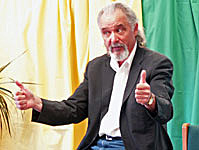
Jim May introduced the Storytelling Institute at SMCC to participation stories. There we were, a bunch of college teachers, with little or no experience teaching or working with children.
Jim was the featured teller at our first Spring Storytelling Festival in 1996. He told in our classes, outside under a little tent, and gave a concert in the Student Union. He told the story of Mr. Wiggle and Mr. Waggle in every setting, and twice during his concert. He wanted to make sure that we had something we could use to engage children! And yet, most of his listeners on the night he told it twice were adults and they loved it! So, I simultaneously learned the story and that participation wasn’t just for children. The pictures at the beginning of the post are of Jim leading the story at the 2006 Clow Storytelling Festival.
Mr. Wiggle and Mr. Waggle is told all over the world. In fact, Irish storyteller Liz Weir says she taught it to a teller in the north-west, who taught it to Jim May, who taught it to us. That’s the way participation stories stay alive. Interactive stories really are best learned from another teller. It’s hard, very hard in my opinion, to get the rhythm, timing, gesture, music, and fun of a participation story from a book.
It’s not impossible, though. Margaret Read MacDonald has shown that again and again in her many compilations of interactive stories. Margaret loves participation, and she has collected unusual ones from around the world. One of my favorites is in one of her early books called Look Back and See. It’s the title story, and Margaret taught it to us when she was at the college a few years back. I loved the story and got the book. She included instructions for telling the story, inviting the participation, and getting the rhythms right. It was all very clear. Nonetheless, I’m not sure I would have been able to tell it if I hadn’t heard her do it.
Do you have a favorite teller of participation stories? Tell us about it!


Leave a Reply