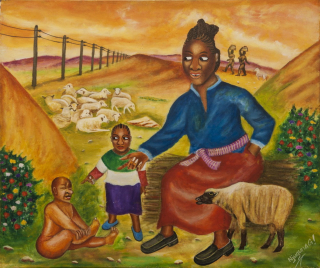
 Folktales are described as “…stories about peoples' lives and imaginations as they struggled with their fears and anxieties by telling tales.” It’s 2019, two years into the election of an American president that rocked everything that I believed in, shook what I had taken for granted and everything I thought were our common beliefs and values. I believed our country was unique, founded on values about the meaning of democracy for all, that far from being perfect, we were always evolving to change and to integrate all the disparities inherent in any kind of aspirational experiment. So the 2016 election of a man I considered to represent all that was toxic about our current iteration of capitalism, progress and the nature of humanity, was elected. Like others, I was distraught. Overwhelmed. Despaired.
But as I began studying folktales at South Mountain Community College, I thought about how these stories spoke to the basic tensions that formed our life in this world. Folktales, I learned:
• Take on the characteristics of the time and place in which they are told
• Speak to universal and timeless themes.
• Try to make sense of our existence, help humans cope with the world in which they live, or explain the origin of something.
• Function to validate certain aspects of culture
• Are passed from one generation to the next.
I loved so many of the folktales I learned, so many of the tales my classmates told, all which were so beautifully expressed, unique, and dense with meaning and metaphor. But often I wondered, what about the folktales of the future? The one we’ll tell TODAY, that will inform the TIME and the PLACE of NOW, speak to UNIVERSAL THEMES. But most importantly, how do we tell tales to the next generations of how we coped with the world as it is now, what we thought was important, why we would give our lives fighting for it.
So I often think of how I could shape and tell a story as if told a hundred years from now. I think it might go something like this:
A long long time ago, we hated each other. I hated you because your hair was blonde/black/grey/brown/red. I hated you because you were rich/poor/homeless/had 15 houses anywhere you wanted them. I hated you because you were thin/fat/medium/old/young/
Then, one day, a group of people huddled together in a cold, dark, damp room, where a small sliver of light came through a slatted window. They took comfort from each other, they had been afraid. “What can we do,” said Juanita, shaking in fear that she would be soon captured and thrown across a wall that separated her from the piece of land where her parents now lived, tossed over it because they had no papers.
Juanita sat in a circle with others, too fearful to express their origins, their nationality. As time passed, they held onto each other, and listened. I am this, I came from there. I came from here, another said, this is who I am. What I feel.
As they held onto each other, the circle tightened, grew close, grew in strength. There was something about the listening that each storyteller grew strength from and this happened night after night after night. Until the time came to act, to stop it.
To stop the fear, the sense of difference, the way we so easily diminish and discount the other. The privileged, the marginalized, the black, the white, the in-between, acknowledged. Valued. Understood.
Then, there was the war. The war between listening and shouting, between being right and not caring, between tolerating and embracing. Between indifference, and putting the device down, and seeing what is in front of you. Like trees.Sky. Bird. Friends. Love.
So here we are. Hundreds of years later. Who can imagine such a time! When you look around and see this rich mosaic, this startling diversity of life in all its wild and amazing iterations, we can only be grateful for the ancestors who knew that STORYTELLING was the magical, mystical key that would bind us forever together, in all our beauty and glory. In all our fears and heartaches. And they did so by listening. By telling their own story. By connecting with each to the other, through their hearts.
(The image at the top can be found here. It's from a post on the BlogCentre for African Writing Magazine that also asks storytellers to create new folktales!)

Leave a Reply