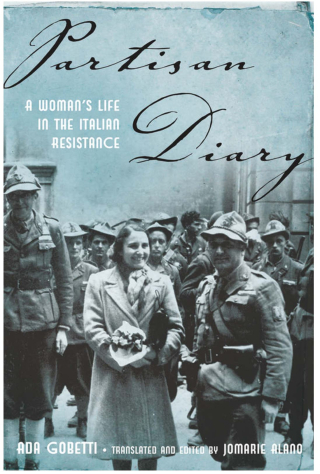
 The other day I told the story of Ada Gobetti, the woman who is credited with starting the Italian Resistance. Before I could tell Ada’s story, I had to set the scene, that of a woman passing out pamphlets on a street corner on a major thoroughfare in the city of Turin in September of 1943. A woman who believed Benito Mussolini’s fascist nightmare to be over and that Italy would finally head into a fresh and hopeful future. A woman stunned to see a string of Nazi automobiles drive right past her.
To tell that part of Ada’s story, I needed to give a little history of Mussolini’s rise to power, his relationship to Adolf Hitler, as well as Ada’s already more than a dozen-years history of resisting the rise of Italian fascism. That meant I had to talk a little about Italy at the end of World War I, in debt, smashed up, ripe for being lulled by fascism’s false promises. I had to speak about Ada’s handsome young husband of the time, his resistance to Mussolini, how his fight got him killed. I had to speak of the unusual bits of Ada’s resistance as a young widow with a young son, of Mussolini’s propaganda arm, ironically titled La Luce, which means The Light. I had to relate the propaganda films to a story for children Ada published in the thirties about a rooster that was sneakily anti-fascist. I had to relate that children’s story to Ada’s post-war publications, parenting help for Italians raised only in fascism who were starting families of their own. I had to speak about the core of Italian culture, her history, the fabric that holds Italy together, Italy’s heart, her home: the Italian family.
And I had to do all that in ten minutes. Because without the context, Ada’s story of a woman in a patriarchal society starting the resistance falls flat, might be confusing. A story told to an audience who may have heard of Mussolini but not understand his role in the twenties and thirties, his part in the Axis powers, his effect on Italian history might feel like no more than a listing of dates and events.
All those bits and pieces are referred to as context and context is everything. Without context, it may be difficult for an audience removed from an event or a person by decades or centuries to connect to the happenings, the attitudes, the nuts and bolts that may have shaped a life, yet finding sources for the context, those bits and pieces that define the times may be difficult.
I am a novelist. A few years ago, I published an article for writers on unconventional sources to round out a historical novel. The article is linked below, the research ideas given as applicable to oral storytelling as to written.
The secret to providing context is the choice of what context to give. The storyteller will find plenty of information that will never make it into the finished story, yet that information provides the web that supports the story. If the story is to be used in an educational application, all that deep research might find its way into discussion questions, or part of a workshop given after. In my process, I write the story down – the main points. Then I note the smaller points I want to make. In time, what context must be included so the audience will understand the story’s purpose become obvious. Context is adaptable to the audience. Careful consideration should be given to the ages of an audience’s members, their backgrounds, where the story is being told, what history might be mother’s milk to them versus history of which they may have no knowledge.
In American folklore, Paul Bunyan is a largish lumberjack on the east coast, by the time he makes it out west he is enormous and carrying an axe big enough to dredge the Grand Canyon. In the east, spaces are closed in, surrounded by trees. Out west, landscapes feel vast, overwhelming. I think Paul Bunyan grew to reflect the changing environs and experience of the people telling his story. I consider Paul Bunyan’s metamorphosis a reminder that I need to be sensitive to the experience of my audience in deciding the context in which to set my stories.
Link to Writer’s Digest Article:
https://www.writersdigest.com/writing-articles/unconventional-resources-historical-fiction-research
Link to the translation of Ada Gobetti’s Partisan Diary:
https://www.amazon.com/Partisan-Diary-Womans-Italian-Resistance-dp-0199380546/dp/0199380546/
Leave a Reply