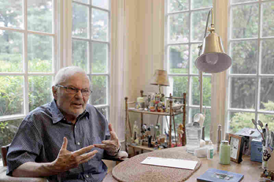
There’s a poignant interview, and his last before dying, between the beloved children’s author, Maurice Sendak, and Terry Gross, the host of Public Radio’s Fresh Air, that for me, epitomizes the sacred. It was not just the quality of his voice— fragile, yet deeply alive and brimming with love and joy. It wasn’t just the hushed, intimate exchange between the two, the shared confidences that millions of us were a witness to. It is moments like this:
(Sendak): And I look right now, as we speak together, out my window in my studio and I see my trees and my beautiful, beautiful maples that are hundreds of years old, they’re beautiful. And you see I can see how beautiful they are. I can take time to see how beautiful they are. It is a blessing to get old. It is a blessing to find the time to do the things, to read the books, to listen to the music.
He grew up in a home without much affection, hid that he was gay from the world even though he was happily partnered with his love, Eugene, for more than fifty years, and dealt with periods of depression and isolation. But he told Gross: "I have nothing now but praise for my life. I'm not unhappy. I cry a lot because I miss people. They die and I can't stop them. They leave me and I love them more. … There are so many beautiful things in the world which I will have to leave when I die, but I'm ready, I'm ready, I'm ready.” And he says: “I don’t believe in an afterlife, but I still fully expect to see my brother again.”
Like Sendak, I am an atheist. I don’t adhere to any faith. I am more attracted to the philosophy of Buddhism, the beauty and poetry of the Vedas, the sayings of the Desert Fathers, who contemplated deeply the words of Jesus who had died a century earlier. What unites these teachings for me is their sense that the sacred lies in our ability to peel back the layers of who we think we are—the false, guarded, delusional self—and see that the only thing that exists is love.
I was raised a Catholic and at the time, and during the fifties and sixties, it seemed to me, there were two distinct branches. There were the League of Decency Catholics who took a pledge not to read certain books or attend certain movies. Who were faithful to ritual, who prayed the rosary, who believed the priests and the nuns could do no wrong. These were kind and devout Catholics, but they were not the ones my parents knew. My mother would not let us take the Legion of Decency pledge: “What! No one can tell me what books to read.” We did not hold nuns and priests in high regard. Ritual was alright, but if you lost the scapular the nuns said you had to wear so that, in case you died, you could go right to heaven, my mother said, “Oh honey, that’s just silly.”
The Catholics I knew gathered every week in my parents living room to talk about their hope for World Peace, the importance of social justice, marched together against the war and for civil rights. We were the Catholics who supported Father Berrigan, and his anti-war activities, who hosted Dorothy Day every year as she helped establish a Catholic Worker community in Tucson, who held signs asking people not to buy grapes at Safeway to support Caser Chavez’s Farm Workers’ Union.
I believed the sacred would exist one day, when we had social justice, world peace, harmony, tolerance, acceptance. When we loved the earth and realized we were part of it, not dominant over it. But the teachings that so opened my heart—- the Eastern philosophies, the Desert Fathers—showed me something different. Experiences over the last 70+ years showed me something different. I found I’d rather be at peace, than right. That the peace I want begins within. That social justice begins when I recognize that the Other I oppose lives in me too.
In the heartfelt exchange between Terry Gross and Maurice Sendak, I find the sacred. He reminds us to look out the window and love the hundred-year-old Maple trees. The connection between the two of them reminds me that the sacred is the gift of always opening to the other. Sendak reminds me that the sacred is in the air we breathe, the sun casting its long shadows on the patio, the humming bird dipping its beak into the flower’s nectar. It’s being true to yourself, It’s forgiveness. Gratitude. It’s what happens when we look through all the illusions and see what’s real.
As Sendak says to Terry Gross: “I wish you all good things. Live your life, live your life, live your life.” And I’d add: live your life, your very sacred life.

Leave a Reply