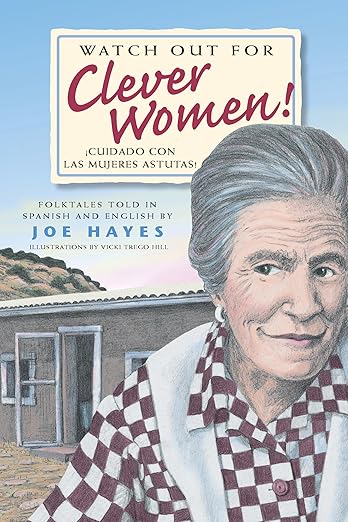
Intending to incorporate a handful of Spanish phrases while learning a new set of traditional stories, I picked up “Watch Out for Clever Women” by Joe Hayes.
Hayes is an early adopter of bilingual storytelling and his collected works are often alternating pages of English and Spanish. It becomes easy to find matches for phrases that I might add to my stories; rancho grande, aye dios mio!
Significantly, Hayes traveled the American Southwest, especially around Tucson and Santa Fe, and collected traditional stories. So when we read him, it is only one degree from the oral teller who spoke it to him. I treasure that closeness.
On his personal website he states, “There seems to be an inverse relationship between material wealth and traditional culture. People who have a humbler, simpler, sometimes more challenging, life tend to value traditions more.” Later in this quote he talks about being closer to the land and closer to the “fundamentals of life.”
I see this when I teach these stories. We use the archetypes of humble farmer, brave wood cutter, greedy money lender, but we don’t know anyone like them. Used to be one degree away probably? I have to go to my grandmother’s brother in Illinois to find a farmer I actually know. So, I don’t know him at all.
These stories keep these personas alive for us, too. We like to say that archetypes in folktales do the work for us — the arcane witch, the gutless prince, the selfish merchant. Like a Homeric epithet, once we hear the name, we know who they are. It’s a kind of shorthand. But what happens when an archetype drifts so far from lived experience that it can’t even conjure a picture? Few people have ever known a prince, of course, but we may be further from that familiarity now than we’ve ever been.
What’s lost when our archetypes become symbols of themselves? For me, part of it is the loss of a certain color in the language — the devout priest, the clever princess, the trickster pauper. We carry all of them inside us. But when they no longer brush past us in the marketplace (the where?), do we lose the ability to see them in ourselves?
Hayes, Joe. Watch Out for Clever Women! / ¡Cuidado con las mujeres astutas! Illustrated by Vicki Trego Hill, Cinco Puntos Press, 1994.
Carly Davis is a Phoenix-based storytelling educator and artist who has worked with hundreds of individuals across classrooms, community spaces, and live events to develop and share personal stories. She was awarded PHOENIX magazine’s Storyteller of the Year, 2025. As an Adjunct Instructor at South Mountain Community College and Phoenix College, her oral storytelling is rooted in trauma-informed practice, and her work explores how personal narrative builds community and connection.
Leave a Reply