 I recently read an article in the National Storytelling Network’s Healing Storytelling Alliance Special Interest Group, Personalizing Myth (2008), by Suzanne Montz Adams. Ms. Adams wrote the article after some extensive research into the writings of Joseph Campbell’s The Power of Myth, and Clarissa Pinkola Estes’ Women Who Run with the Wolves. Her readings and subsequent experiences in healing settings reawakened her awareness that myth can be a vital source of “soul wisdom.” It is a beautifully written article that explains her exploration of the application of myth to the 21st century. It is informative and entertaining, and reaffirmed my belief that all stories have healing potential.
No matter what story I hear I find myself experiencing different emotions; sometimes joy, sometimes tears – but nearly always the stories allow me to see myself and the stories I have locked inside. As a relatively new personal storyteller, I have trouble exploring my past, and rediscovering family wisdom. It is a difficult process and often dredges up painful memories. I respond well to prompts that help me explore my innermost thoughts, but nothing works quite like hearing a story. The saying that “stories beget stories” is absolutely true for me.
Donald Davis said, “The real difference between telling what happened and telling a story about what happened is that instead of being a victim of our past, we become a master of it . . . We can’t change our past, but we can change where we stand when we look at it.” Mr. Davis is the master of personal story, but I think his thoughts reflected in this quote are more than applicable to the stories we hear. As we project ourselves into the stories we experience through listening, we become the hero, the victim, the trickster – whatever need must be fulfilled at the time of the hearing of the story. We may experience the story several times, and take something different away; the story “simmers” with us until its message is finally delivered.
The myths that informed the world so long ago remain alive today because they retain the power to speak to us. In Personalizing Myth, Suzanne Montz Adams said, “ By connecting with myths, personalizing them with our own stories, and discerning awareness and meaning from that process, we are healing ourselves, emotionally, physically, and spiritually.” The archetypal characters in myths connect with us on a subconscious and conscious level. We delight in their familiarity and find the struggles and desires of our everyday lives reflected in the characters in the stories. These familiar themes are a powerful healing tool, empowering generations young and old, with a sense of possibility and wonder. They find us, wherever we are in our journey, and bring us to new levels of awareness. We might not like what we learn, but we learn, and we yearn for more.
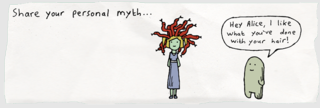
I have been exploring the use of myth and its potential to add a sense of familiarity and structure to a personal story. Weaving a story of my own through the well-known themes in a myth that resonates with an audience can create a sense of wonder, provide a glimpse into a personal aspect of my hero's journey, and gift the listener with his or her own recognition and relationship to the story. Such is the power of story and the value of myth. As Ms. Adams said, “All we have to do is claim the myth’s wisdom and watch as it reflects light into our own lives.


Leave a Reply