Friday, June 8, 2018
The first Friday of the program is the day we go to Loughcrew in County Meath. It’s part of the Boyne Valley Neolithic ceremonial complex that includes Newgrange. As Jean McMann notes in her book, Loughcrew: The Cairns, “People have probably been telling stories about the Loughcrew Hills for more than five thousand years.” The stories I know best and love most are about the Cailleach, the titanic, earth creating goddess who is credited with creating the cairns on the tops of the hills by filling her apron with boulders and then jumping from hill to hill to distribute them.
Loughcrew is made up of three hills, and the center one is called the Sliabh na Cailli, or Sliabh na Caillighe (both these spellings are on signs at the bottom of the hill), which means Hill of the Cailleach, or more commonly, Hill of the Hag. A fourth hill, Patrickstown, is often called the grave of the Cailleach. There is a heap of stones at the base, and a story says that as she tried to jump there she fell, broke her neck and dropped the rocks in the wrong place.
The Sliabh na Caillighe is the only hill that the public can access. There is a little car park about midway up the hill, and it is always staffed by people from the Office of Public Works. Cairn T, the largest on any of the hills, is aligned to the equinoxes. On those days, the sun shines straight down the passage and illuminates the carved stones at the end of the passage in the center of the cairn. George Knight, a guide that worked at Loughcrew for several years, explained that this was the sun fertilizing the body of the goddess to bring life to the land.
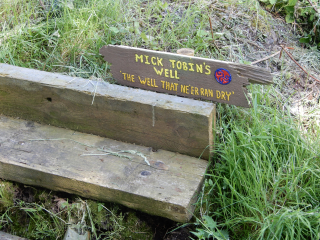 The day was cool and a little rainy – the first cool day we’d had since we arrived, as Ireland had been experiencing a hot dry spell for almost two weeks. We always stop for lunch before we climb the hill. In the past, we’ve stopped at Loughcrew Gardens, down the road about half a mile from the steep, narrow road that leads up the hill. This year we went the Loughcrew Megalithic Center, which is just 100 yards around the corner from the carpark. One of our students, Cynthia Herda, was exploring as she waited for her lunch, and she found a well that had been dedicated to Mick Tobin. Mick was a man of great local knowledge, and a fixture at Loughcrew for many years. When he died, a monument was erected to him in the carpark on the hill, featuring a poem written about him by George Knight. Cynthia had read about Mick in a blog post of mine and came running to ask if I knew about the well. I hadn’t seen it before, and wouldn’t have if we hadn’t changed lunch venues, and if Cynthia hadn’t gone wandering!

The Cailleach isn’t the only Loughcrew based celebrity to have stories told about her. When I searched The Schools Collection (duchas.ie) for stories from Loughcrew, I found several about her but also about the mythical foster mother of the god Lugh, Queen Tailtiu. The site is also associated with Ollamh Fodla, a legendary lawgiver, and the lands around Loughcrew once belonged to Oliver Plunkett, a Catholic martyr executed in 1681 and beatified in 1920. Check out these seven stories about Loughcrew from duchas.ie 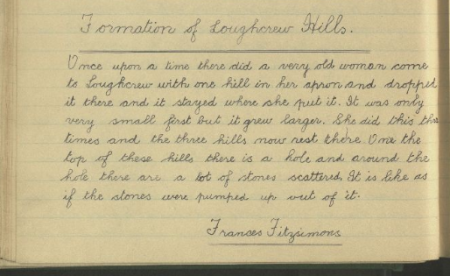
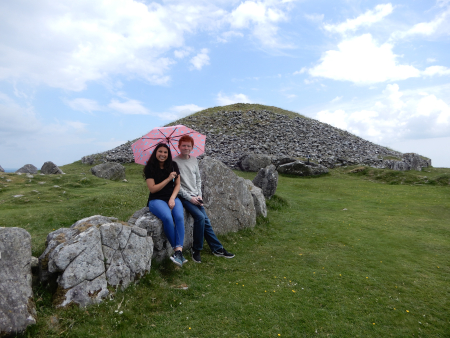
(The image at the top is Emma Abreu and Nik Dunlap on the west side of Cairn T at the Sliabh na Caillighe, the next is of Mick Tobin's well, and the last is from Frances Fitzsimmons' copybook.)
Leave a Reply