 I heard another story involving saints, aprons, and rocks at Glendalough, the home of St. Kevin in Wicklow.
St.Kevin was concerned that people not be greedy. One morning about breakfast time he met a woman carrying loaves of bread in her apron.
He asked her for a loaf, but she said, “Oh, no, Brother Kevin. These are not loaves of bread, but rocks I’m carrying to line the hearth.” Kevin knew better and said, “If they really are rocks, then let them be loaves. But, if they really are loaves, then let them be rocks.”
Since they really were loaves, they were instantly changed into rocks. They tore through the woman’s apron and scattered on the ground. This presumably taught the woman several painful lessons, especially if any of the rocks happened to land on her feet. Once again, as with St. Patrick and the Cailleach, a saint causes rocks to be dropped from an apron.
There’s another story, though not Irish, involving a saint, an apron, and loaves of bread. The future St. Elisabeth of Hungary was married to the Landgrave of Thuringia. While he was away managing a war, there was a famine in Thuringia and Elisabeth began giving food to the poor. Her mother-in-law, who was ruling in the Landgrave’s absence, forbade Elisabeth from distributing food. One day Elisabeth’s mother-in-law caught her with her apron full of loaves of bread for the poor. When she confronted her daughter in law, Elisabeth said, “Oh, no, Mother. These are not loaves of bread. My apron is full of roses!” When her mother-in-law demanded to see, Elisabeth lowered her apron to reveal the white, pink, and red blossoms.
My glib response would be that we might trust a woman saint to produce something beautiful rather than causing a lot of rocks to be dropped all over the place. That doesn’t really work, since the rocks that the Cailleach dropped at Loughcrew are magnificent. I think the real difference has something to do with perceived power. Both St. Patrick and St.Kevin believed, and in the stories were proved to be, in positions of power relative to the women in their stories and their power had tangible weight and force. Elisabeth on the other hand was not in a position of power relative to her mother-in-law and she knew it. She could not risk a titanic confrontation. Elisabeth relied on her God-given miraculous power to deflect her tormentor and to save her ministry and the result was as light as a petal.
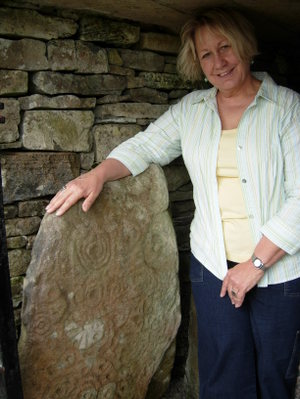
In the picture at the beginning of the post, I’m standing next to one of carved stones at the opening of the passage of Cairn T at Loughcrew.
Leave a Reply