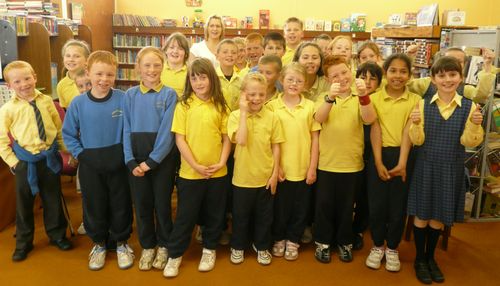
Yesterday I had my third and last session with the Third Class at
Scoil An Chroí Naofa (pronounced skwel on kree nayfuh), at the library in Ballinasloe. Scoil An Chroí Naofa, or Sacred Heart School, is a national school which means that a large portion of the curriculum is conducted in Irish, or as Gaeilge. More and more Irish-language primary and secondary schools are cropping up all over Ireland, leading to a resurgence of the Irish Language.
According to the Irish Tribune of June 7, 2009, the U.N. has recently upgraded Gaeilge from “endangered” to “vulnerable.” The article goes on to say: “Where did it all go right? In less than two decades, we’ve gone from shunning the Irish language and associating it with all we wanted to deny about our nationality to endorsing it as a fashionable and positive thing – a quiet(ish) revolution that the Irish public is all too willing to be part of.” Clare Murphy confirmed this when she was here earlier in the month. She told us that Irish was sexy again, since many more beautiful young Irish people on the television and in entertainment are now openly fluent.
But back to the bilingual children of Scoil An Chroí Naofa. Each week that we worked together we got more comfortable with each other. The first week I started off with a story about Finn McCool. I then told them “A Whole Brain,” and “Why Rabbit Has a Short Tail.” We reviewed the stories together, and then I put them in pairs and asked them to tell the stories to each other. Then, three or four of them came up and told for the whole group. Before they left, I reviewed with their teacher, Miss Murray, what I hoped to do the following week. She said she thought it was worth trying, and agreed to have them formed into groups of four before they came.
When they arrived for the second session, I could tell they were feeling more comfortable. I told a couple of short stories, and then with the help of Miss Murray and another teacher, we led them through an exercise called “Learn a Story Fast.” Most of them were able to learn the story in their original group and then to share the story when they were reformed into new groups. Then five of them came up to tell their stories to the whole group. We finished with “Mr. Wiggle and Mr. Waggle.”
The third session was devoted to personal and family stories. I started with “Ballerina Eyelashes,” which got us talking about baby brothers and sisters. Then we moved on to scar stories, and stories about a time they tried to play a trick that had failed. I told them a story about my goat Josie, and that got us talking about pets and farms. I told “The Horny Toad’s Grandparents,” and that provoked stories about gardens and grandparents. Most of the children shared something during the session. We heard some great stories and there was a lot of giggling. In the last few minutes someone called out for Mr. Wiggle and Mr. Waggle, so we ended the session with that. I wish I'd had more time with them, but we accomplished a lot in our three sessions together.
These are some of the students that I’m hoping will participate in next summer’s international children’s storytelling exchange program. I talked with Miss Murray about it and she’s game. Mary Dillon, the librarian at Ballinasloe, has been a supporter of the idea since we first started talking about it last year. The exchange will be between Irish children in Ballinasloe and Athlone and the storytellers from Tertulia that Marilyn Torres and I have been working with for the last three years.
Anybody interested in being the title sponsor or the fairy godmother for a ground-breaking international storytelling exchange program for children?
Leave a Reply