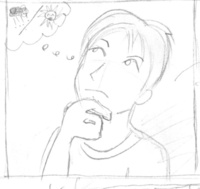
 The day before Liz Weir came to class, the students in the Irish Storytelling Tradition experimented with creating simple storyboards as a technique for learning their stories by connecting to its images. Through this exercise I learned that Allison Davis is considering storyboarding as a major once she selects which design college she will be attending. She spent a couple of days working on hers and the finished product was three full pages. The panel at the beginning shows the hero of the story pondering why his mother, a horrible person, got a sunny day for her funeral, while his father who was loved by all had a rainy day for his.
Thursday, June 21st was the day for their second in-class telling. Below are the stories they told, a brief summary of the story or some of their thoughts on the process.
-
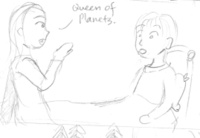 Allison Davis told "The Queen of the Planets" which she found in Folktales of Ireland by Sean O’Sullivan: “Storytelling, I’ve come to feel, really is a balancing act and you can only get better at it through practice. Overall, I think this was a successful telling. I even made people laugh! Something I hadn’t planned on. It just goes to show how storytelling is an “in the moment” form of entertainment. But now that I think back to my storyboard, I did put a lot of subtle humor into it that made me chuckle. I guess that just came out in my telling as well!”
 -
Amanda Ryder told "The White Trout", which she found on the Sacred Texts website: “The story had a great impact on me because very rarely does the bad guy repent in stories. In this story the woman/trout makes him realize the error of his ways and as a result he becomes a man with a conscience and a good attitude. I really liked that.”
-
Jeff Aspland told "Diarmuid’s Longing", from Laura Simms’ book The Robe of Love: “I liked the story because it has alot going on. Dairmud has to go on a quest to save the one he loves and it just seems very exciting. The ending also made me choose this story because it isn’t what you would expect. Adventure stories usually have a happy ending, but not in Irish tales.”
-
Skippy Covington told "The Weakness of the Ulstermen": "The story is from the book Over Nine Waves by Marie Heaney. I read the story from this book and from The Tain. I then spent several days going over the story in my head. I also did the story board drawing which helped. I also spent some time thinking about how to relate it to not only myself but also the audience I would have. My favorite part of description was when I was describing the king’s horses, how they were so magnificent and fast that they would be a blur as they ran by yet you could still see every detail. I drew this description from my own life experience. When I was younger my grandfather would tell us about the horses he used to raise and a specific one he would race. One time he showed us a video of the horse that was so blurry that you could barely tell it was a horse. But I had heard the description so many times I swear I could see every detail of that horse in the video. So I used that experience to help describe the king’s horses.
-
Doug Bland told the story of St.Deirbhle’s well, and how he came to learn about it: “I prepared this story by recounting the events leading up to the story and the story itself several times to friends and classmates. The story is especially important to me because it was based in and grew out of personal experiences that I had here in Ireland as I met local people and explored the theme of “living water.” I was deeply moved as I heard, from several people in Athlone, the story of how this well was efficacious in the restoring some sight to the eyes of Maurean Eagan.
-
Joyce Story told a story called "Taken" from Henry Glassie’s Irish Folktales. It’s a very sad story about a woman who seems to have died, but has actually been taken by the fairies. When she turns out to be alive and contacts her family, her husband has remarried. They decide to try to rescue her and send her to America to start a new life, but the priest forbids them. He says that a man can only have one wife, no matter what the circumstances. The family obeys, the woman is not rescued and returns to the fairy hill to eat their food and live with them forever. It was an excellent fit for Joyce’s voice and she told it well.
-
Ashley Dobbins told "The Changeling" by Batt Burns from More Ready to Tell Tales by David Holt and Bill Mooney. In this version, the fairy mother of the changeling comes to tell the family how to get their human child back so that she might have her own back, too.
Below are the panels from Allison’s storyboard that lay out the hero’s dilemma regarding his parent’s funeral days.

Leave a Reply