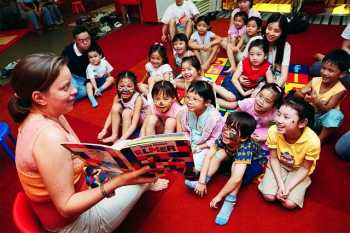
 I am going to start right off the bat and assert that storytelling and story reading are different. I am not saying one is better than the other especially when it comes to young children who are early readers. I am just saying they are different.
Storytelling is the art of orally telling a story handed down from the oral tradition to one or more listeners.
One could argue and say that a folktale read aloud to a group of second graders fits the definition of storytelling. And this is where I would explain that for me the key phrase in the definition above is, “the art of”. What makes storytelling an art is the creative freedom the storyteller has to infuse their own personal element into the story without the binding limitations set by having to read a story.
Personal Element
When telling a story, the storyteller is free to create and craft the story. That is why you may hear a well-established story and it will sound different when a different storyteller tells that story. This is because the teller has incorporated their own personality into the story.
Chesin states, “The storyteller is free to present the tale as he knows and loves it” 1
At a recent Summer Solstice event I told the very well-known myth, “The Abduction of Persephone.” While I had told this story a couple of times before, for this event I decided to craft it a little differently and told the story through Demeter, Persephone’s mother’s point of view. Though this is quite a serious and some may say a tragic story, I did add some humor to it because that is my style. Later I was told by a guest that she really enjoyed the story and while she knew the story well and had read it to her grandchildren many times, she had never heard it being told this way.
While the story elements; place, characters, plot, were the same, as a storyteller I had the freedom to create a piece of art through which the audience got a glimpse of my personality.
Binding Limitations
With storytelling the storyteller is not bound by the words printed on paper (or in this time of technology on a device). The storyteller can take a well-established story and make it their own.
A couple of months ago, I heard a book on CD read aloud by Tom Hanks. He did a fantastic job of bringing the book alive by using different voices for the different characters and changing his pace and tone to express emotion. Nevertheless, he was bound by the words of the author, and he was expressing the emotions of the author.
Because the storyteller is not bound by printed words you may hear a storyteller tell a story again and it will sound different. The storyteller has the freedom to lighten the mood by adding humour if they see the listeners getting too stressed or get the listener’s waning attention by adding a sound effect to the story.
Words are not the only limitation readers encounter. They are also faced with the barrier that a book presents, coming between the reader and the listener.
As a teacher I want to reinforce the importance of reading stories aloud, especially to young students who are emerging readers. And even as an adult I like having a story read to me and often listen to a book on CD on my commute from work. While story reading is important, it is not storytelling.
|
Storytelling |
Story Reading |
|
Storyteller and the listener |
Story reader, listener, and the book |
|
Creative and improvised |
Bound by the words of the book |
|
Takes effort and work to create |
Is easier to do |
Watch this short video of Debra Weller demonstrating the difference between storytelling and story reading.
The image at the top of the post can be found here. Is she telling or reading?
Leave a Reply