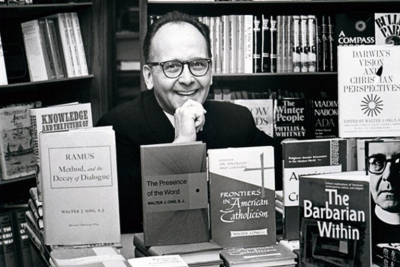
I believe that the art of storytelling is, by its very nature, a sacred practice. In my view, no one has articulated this notion with more clarity than cultural historian Walter Ong, S.J. His book “The Presence of the Word” was dropped in my lap in 2003, and it really spoke to me. Still does.
I’ve organized my understanding of Ong’s premise into five axioms:
- The word was spoken before it was ever transposed into derivative forms like writing (which took the “winged word” and stored in like an object). Thus, the spoken word is primordial, our most basic nature. If you believe in a creator, you could see this primordial nature as our divine nature, by design.
- My primordial nature is also your primordial nature. Oral culture is actually oral-aural – not just a voice, but also an ear. Ong describes our connecting to one another with the spoken word as “primordial attunement.” In other words, we need each other. The human body is constructed to connect with (attune to) other human bodies. What good is a voice if there is no ear?
- Ong posits that making this voice-ear connection to one another is how we experience the presence of God. (I believe it’s also true that one can experience the divine by going inward, but that’s a complementary, not a competing notion.) This is not to say that you are God or I am God, but that our interaction brings the presence of God into our consciousness. Martin Buber called this dynamic “the I-Thou.”
- Therefore, because it a mechanism by which we can experience the presence of God, the voice-ear connection is sacred by its very nature. A particular story might have explicitly sacred content, or not. But in every case the practice of storytelling is sacred because it is our God-given nature. It’s what the human body is built to do.
- Here’s the part that gets lost in the digital age, and why it’s crucial that we keep the practice of oral storytelling alive: The fact that oral expression is our primordial/divine nature is still true today. Ong says (emphasis added): “The word is still always, at root, the spoken” It’s harder to see the truth of this today because of all the other ways that we communicate, using electronic devices as intermediaries between our bodies, but it’s no less true. Writing is still the derivative of speech, not the other way around. Texting is another derivative. Radio, podcasts, YouTube, you name it. All derivatives. Which is fine as far as they go. Ong makes the point that we don’t have to reject technology, but we should keep it in perspective. The communication devices that humans have invented are secondary to the communication device that God invented: the body. Practicing the art of oral storytelling in the digital age ensures that our primordial/divine nature is not completely obscured by shiny objects.
Practicing the sacred art of storytelling today does NOT mean we are going back into the past. Storytelling is an ancient art, yes, but it is also a contemporary practice. We are compelled to bring our primordial nature to life in the present moment because it’s what we’re supposed to be doing. And if you believe that our primordial nature was given to us intentionally – the mechanism provided by God so that we might experience the presence of God – then it follows that the practice itself is still and always will be sacred.
What do you think?
End note: As I was fine-tuning this essay, I had to smile. I realized that Ong’s insights about our oral-aural nature were presented to me on the printed page, and I am communicating my thoughts about oral-aural culture to you using a digital platform. So here we have relatively new communication tools being used to celebrate the primordial one!
Resource: Ong, Walter J. The Presence of the Word: Some Prologomena for Cultural and Religious History. (Binghamton, NY: Global Publications, 2000)

Leave a Reply