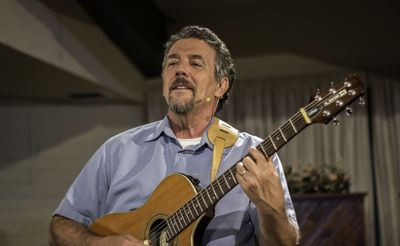
 On September 25, 2015, I presented a solo performance of original stories and songs, “The Cracks Are Where The Light Gets In,” at The Whole Life Center at Shadow Rock UCC in Phoenix, Arizona. The show was warmly received by an audience of about 70 people, and it affirmed the power of personal storytelling.
“The Cracks…” is the fourth iteration of my work with personal material in a context of “art and healing.” The first three shows were performed at The Empty Space at Arizona State University: “Outlets” (2005), was like a TED Talk with songs—some, but not all, original—exploring the notion of “making music as a way out of the ‘Dark Night of the Soul.’ In “Evening Song” (2010), I presented my mother’s unpublished poetry—some set to original music—again using a framework of creative material within a running explanation/lecture. Finally, in “Family Cries” (2014), same framework, I blended my mother’s poems and my songs to reflect how we both turned to the creative process to get through grief and experience joy once again.
In February of 2015, I participated in a 4-day intensive workshop with Tanya Taylor Rubenstein, a solo performance coach based in Santa Fe, New Mexico. She patted me on the head and threw out my script! We did an exercise where I went back in time. I saw myself in the backyard at the age of eight, bugging my big brother to play with me, etc. Tanya said, “I want to you to write a scene that starts there, first person, present tense, and ends with you as an adult at your brother’s funeral. Include some of the song if you want, but just a verse or two, and only if the lyrics don’t cover the same ground as the monologue.” I wrote into the wee hours, and the next morning I performed the scene for her and the other students. It was a watershed moment. The lecture was gone; the story was born. I continued to work with Tanya to develop new material via email and Skype through the spring and summer. Nothing changed in terms of the life experiences I wanted to share with an audience, but everything changed in terms of how I shared my story.
Having all four shows to look back on, there is no question that the new theatrical approach—original monologues where I am in the scene rather than observing the scene, combined with short portions of songs—was much more entertaining and accessible for the audience than the presentational lecture with music. (One definite plus was that I was able to bring in more humor from life experience, more than the songs can do.) The shows at ASU were in a scholarly context, which has its place. But it was a lot of work for the audience, ping-ponging from left brain to right. I would say things like, “Neurologist Oliver Sacks says that music stirs our soul because…” and then I would sing a song and hope it would stir some souls. But if Dr. Sacks could have seen “The Cracks…” he would have observed, “Look at all those stirred souls!” The emotional connection didn’t have to be explained to the audience, they felt it.
The theme of “The Cracks…” is that grief can be illuminating and liberating—we can find beauty in our broken places, like the light that seeps through the cracks of broken pottery. Tanya did me a favor by shattering my old script. That’s what made it possible to see my story in a new light.


Leave a Reply