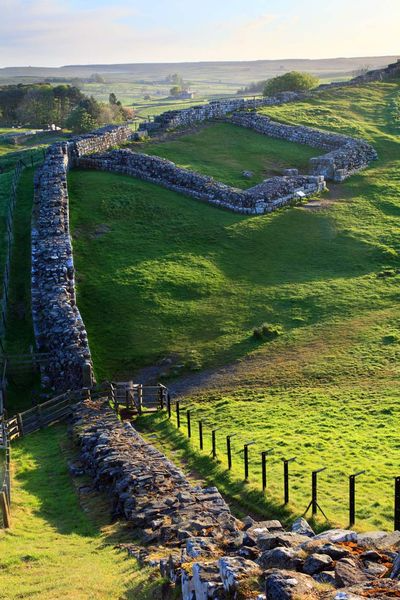
From dusk ‘til dawn, young Lucius patrolled the wall. It was a lonely undertaking, fraught with cold and mists, and too much time to think thoughts that didn’t improve the circumstances, but made them worse.
“Five more years,” he often said to himself. Lucius had been a boy of 12 when he was conscripted by the Roman Legionnaires, the greatest army in the world. Rome took soldiers from the peasantry; auxiliary forces numbering in the 12,000’s – they made up a security force, often guarding the perimeter of Roman territory. Lucius was such a man – his name changed to suit his Roman uniform. Fifteen years he would dedicate himself to the cause of safeguarding the land and loyalty of the Britons – then he could return to his family farm, marry and live his life cultivating the land. He loved the rich, fertile hills of Britannia, and dreamed often of his future.
Lucius walked the same route – beginning at Milecastle 42 and walking toward 43 – meeting his counterpart with a stiff salute and occasional conversation, before turning around and heading back. Over and over again he walked the top of the wall – looking to the north – where there had been no raids for many years. Yet still, his mind was filled with a fear of the mysterious people who lived in the land to the north. Strange people who seemed to be a part of the mist – their faces painted blue, their bodies tattooed. They were reported to be fierce fighters during the years when the Roman Empire hoped to expand to the northern territories. The expansion was abolished – for the most famous fighting force in the world, the Roman army, could not defeat so mysterious a foe. He pondered the possibility of meeting such a man. He had heard that those near the western sea wore seal skins, and that they could turn into seals when they entered the water. He shuddered at the thought . . . but his lonely vigil continued with no glimpse of strange, northern warriors appearing from the mist. He only saw the wanderings of peasants who crossed the wall at the milecastle gates, on business that was approved by the army.
In fact, Lucius had lost his heart to one such peasant woman. He met her three months earlier – she just appeared one night at the wall when he began his evening vigil. “She must be from the village at the end of the forest,” Lucius thought. She looked up at him on that cold night, offering him wine and hot baked bread. He had to admit, that the rough bread baked by the peasants was delicious – it reminded him of his childhood. Knowing he was violating the rules, he climbed down from the wall and spent some comforting moments enjoying the bread and the company of the lovely young woman, whose name caused his heart to beat – Eanfritha. “Call me Fritha,” she said. Just thinking her name made him smile. As he walked the wall, he thought of her face, her plump young figure, and the kisses he had stolen in the night.
Fritha met Lucius regularly – their bond grew as they talked and embraced in the silent, secrecy near the wall. Who would catch them? No one ever came near. The wall was guarded by few men and they walked at regular intervals – the same schedule day after day, night after night. Lucius and Fritha grew bold as they pledged their love to each other. He promised to marry her and take her to his homeland in southern Britain, where they could start a family and work the land together. They talked endlessly of their plans and their future filled with hope and promise. Fritha vowed to wait ‘til his service was complete. They were young and it was a time of peace; there was no reason to doubt that their dreams would come true.
But Fritha was not entirely honest. While she entertained Lucius, her brother Ethilric scaled the wall and raided the Roman village nearby. He stole coins, food and supplies – in small enough amounts that he didn’t raise too much suspicion. Fritha kept Lucius occupied just long enough to guarantee the safety of Ethelred’s dishonesty. There has yet to be built a wall or fence that clever or dishonest people have not found a way over.
Ethilric was a loose-tongued young man who boasted of his successful “export business” quite often, and it wasn’t long before he was arrested in the village. While being questioned, Ethilric denied the charges, but when faced with the prospect of death, in a panic he accused Lucius of being duplicitous in the crimes. Lucius also denied the charges, but admitted to having a relationship with Fritha. Imagine his heartbreak when he realized he had been so ill used by the woman he loved?
Poor Lucius was facing disgrace and dismissal from the army. He would be forever marked as a traitor and thief. Unable to face such shame and suffering a broken heart, Lucius took his own life – in the most honorable way a Roman soldier could die. He fell upon his own sword. He did not immediately die, but suffered greatly. Fritha heard of her lover’s plight, and feeling guilt and responsibility for what had befallen him, she visited his sick bed and did her best to nurse him to health. It seemed for a time that he might survive. Perhaps all their plans could come true? Lucius caught a fever and died three weeks later.
To this very day, a ghostly presence walks the top of the wall. In fact, he walks at the original height – seeming to glide above the ruins. He begins at Milecastle 42 and walks to meet his invisible compatriot, then turns back. His presence has been seen in daylight as well as night. Lucius, the young soldier whose dreams were foiled by the betrayal of love.


Leave a Reply