 Recently my grandson, Lukas, asked me for a story about a search for a golden baseball. It came out of the blue while we were sharing a snack at the kitchen counter. Immediately it resonated with me – I knew this would be an important epic story that could help bring healing to our family and keep his Dad and me in meaningful relationship with him. We had been wondering how to do this since we learned that Lukas would move to Michigan.
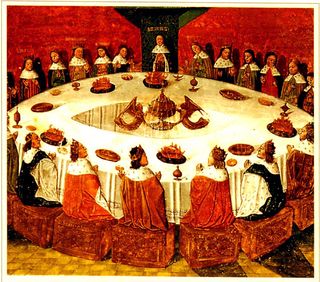
I pondered awhile, wondering how do I tell such a story? It soon became clear to me that this would be not one story, but several stories. Oh! A hero’s journey – a Grail Quest. I had heard of King Arthur and his Knights of the Round Table and some of the famous characters – Lancelot, Perceval, Galahad, the Maimed Fisher King, and Queen Guinevere, of course. But I have never read the stories. Like folk and fairy tales, I had discounted the value of these stories because of their violent and sexist natures.
But … well … this seemed like one of those serendipitous ideas I have learned to pay attention to. So I set about my own quest to learn about Grail stories. Reading stories about King Arthur and his knights, as well as various commentaries upon them, is proving to be an oh so interesting quest. You see, once upon a time (in the late 1100s), Chretien de Troyes, a Frenchman, began an epic poem, Perceval or The History of the Grail, in which he plants the seed of a spiritual quest through his fusion of pre-Christian (Celtic) and Christian elements. He died, leaving it unfinished. Several continuations were written, but probably the most well-known is that of a German writer, Wolfram von Eschenbach, who wrote Parzival.
These stories seem to be quite relevant to our current times, as they point to an inner spiritual quest in which the feminine and masculine are brought into balance. One of my favorite stories is The Once and Future King by T. H. White (first copyright 1939). He depicts King Arthur as wanting to create a new kind of law – one where Might was to be used only for Right. Instead of punishing “bad” knights, they would try to bring them into the Order of the Knights of the Round Table. These knights would “ride all over the world, dressed in steel and whacking away with their swords, … bound to strike only on behalf of what is good, to defend virgins, … and help the oppressed.” This would give the men an outlet for their inherent fighting spirit (p 248).
Later in the story, Arthur realizes that though they had achieved peace and prosperity, that was not enough to hold the Table together. If they turned their energies to the spirit, he reasoned, if their Might was channeled into working for God, instead of the rights of man, “surely that would stop the rot, and be worth doing” (p. 434). They came up with the idea of searching for something that belonged to God himself.
What is so interesting to me about these stories is how they have set the stage for our current system of justice. I see so many parallels between what Arthur and his knights were trying to accomplish and what is espoused in our courts. Since a major focus of my storytelling work now is on the criminal justice system, I am finding a lot of grist for my story mill.
I am also noticing how healing it is to read the stories – they are so applicable to what is happening in my family. It is so exciting to experience the healing power of myth!
Now, you may wonder, haven’t we strayed from the search for a golden baseball? Actually that is another arm of this quest that will be the subject of my next post.


Leave a Reply