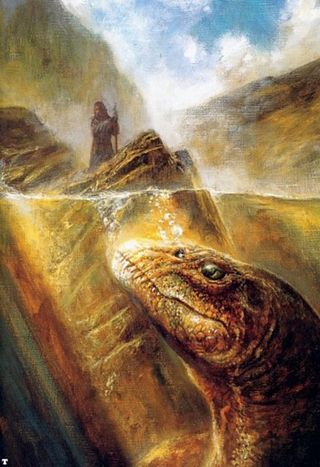
 Columcille, the saint known as the “Dove of the Church,” went travelling through Scotland, living out his vow to bring as many wild blue Picts to Christ as there were souls who had lost their lives in his battle against the High King of Ireland. One day, as he led his faithful band of twelve monks along the shores of a narrow Scottish lake, he came across a heartbreaking scene – a young woman mourning the death of her brother. The Pictish lad had made the mistake of trying to swim across the river that fed the lake. As soon as he entered the water, he was attacked by the local monster, a terrible swimming creature with a long snaky neck. The young man now lay bloodless and lifeless on the rocks of the shore.
Columcille was enraged. He ordered one of his monks to swim across the river to retrieve a boat on the other side. The monk obeyed without hesitation but, as soon as he entered the water, he too was attacked by the terrible creature. The Picts and the monks froze in horror as Columcille raised his hand and commanded the monster to halt.
The monster immediately cowered at the saint’s feet. Columcille proceeded to rebuke the beast, to forbid him from ever again harming man, woman, or child. The beast’s diet was to be limited to sheep and the occasional cow.
The Picts in the vicinity were vastly impressed and immediately converted to Christianity.
This episode in the Life of Columba as recorded by the Abbot Adamnan some two hundred years after Columcille’s death, occupies an interesting intersection between history, legend, and myth. Columcille himself was a historical figure, a member of the of the Ui Neill (O’Neil) clan in Gartan (Donegal). He entered the church at a young age and rapidly became an Abbot who founded a number of monasteries. But there is more to Columcille and his monster than faith and history. This will be explored in my next blog entry.
Columcille was clearly a man who attracted stories. It is said that his disagreement with the High King of Ireland began as an argument over the copying of a Psalter – the first known copyright case. It is also said that he left Ireland vowing never to let his feet touch Irish soil again. When it was necessary to return to his homeland, he wore blocks of Scottish turf on his feet! Many of the wonders attributed to Columcille are closely modeled on the miracles in the Gospels. Columcille is seen expelling demons and raising a young child from the dead. The episode with the monster is something else again.
Monster killing is an ancient Indo-European custom. In How to Kill a Dragon: Aspects of Indo-European Poetics (Oxford University Press, 1995) Calvin Watkins explores the linguistic connections between Indo-European languages found in the phrase HERO SLAY BEAST (with weapon). The lists of Indo-European heroes and their beasts is a long one: Sigurth and Fafnir, Beowulf and Grendel, the boy who fed a Polish dragon a sheepskin of sulphur and tar, St. George and his dragon – these are just a few of the possibilities.
When Columcille faced his monster (and yes, it was Nessie) he was taking his place in the wide-spread myth of HERO SLAY BEAST. In Columcille’s case, his weapon was his faith and his voice. He did not physically slay poor Nessie, but he turned him (her) into an object to be hunted by the curious. Nessie even has a webcam now – and that’s quite the rebuke from the saint.
The image at the top of the post came from here.


Leave a Reply