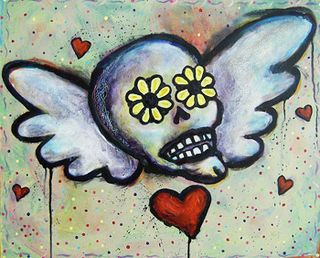
The Legend of La Llorona by Joe Ray

Legends, myths, and fairy tales define who we are; they're culturally based. We define ourselves by our legends, or someone else will define us in their manner. Our legends have various meanings and intentions, much like George Washington and his cherry tree or Davy and the bear slaying at the age of three (good one!).

One legend that comes to mind is the legend of La Llorona. I grew up hearing about La Llorona from my mother, aunts and other women around me. This more modern day Medea was used to keep kids in line and to keep them away from rivers, canals, waterways, etc. In this version, La Llorona was a beautiful woman who killed her children to be with the man that she loved, only to be rejected by him. Now she wanders through eternity…weeping and haunting unsuspecting kids. Man, I always loved these cheerful stories!

Here's my take on La Llorona: Evidently, La Llorona started out as a lovely lady with a bunch of kids who drove her nuts. By the time she had reached her wits end, she had also met a studly macho that she fancied…so she wanted out of her situation. But this new guy didn't like kids and didn't want them around. I guess this left her few options. So she did what she’s best known formato a sus niños – she killed her kids. She drowned them in the river. Once she’d realized what she had done, she went mad and killed herself. So from this point on, she wanders through eternity searching for her dead children around water. It doesn’t matter if it’s an ocean, a river, a lake, a canal. She’s out there looking for those kids.

When I was seven or eight years old, we lived in a trailer camp which was a housing area for farm workers. My friends were from different parts of Mexico, this meant different outlooks, and of course, more stories of La Llorona. We all shared a “healthy” fear of La Llorona. My favorite one of these stories was from my friend Ricky. He had a tió, an uncle, who lived on a small farm in Mexico (near a river) and he was having issues with La Llorona. The uncle could hear her wailing into the night, sounds coming from los arboles,the trees. This caused his cows to produce sour milk and stillborn calves. His crops were dying. But I don’t think he had issues with his kids misbehaving. The uncle decided to do something about this so he placed crosses made of white flowers on the nopales and ocotillos on the perimeter of his farm near the river. He did this in meticulous manner, with the crosses forming a pathway leading away from the direction of his farm.

Apparently this worked. The following night as the uncle heard the wailing and weeping, it turned into screams of fear and pain. The screams faded away from his farm, down the direction he had intended for her to go. Finally, the screams could be heard no more. From that point on, the cattle were fine, as were the crops. La Llorona had been banished forever from this part of the river. Life returned to normal. Except that the uncle had committed sacrilege by placing holy crosses on thorny vegetation. This resulted in the uncle having his own stigmata on his hands. I guess this made his hands bleed periodically as if pricked by cactus thorns. Other than that, everything else was okay.

Living in this farming area on the Colorado River during the 60s and 70s, we were surrounded by fields and canals. I swear that sometimes when I sat outside at night, whether by myself or with my friends, I could hear La Llorona in the background…looking for her kids… any kids. And me, I just kept my distance. I still keep my distance.

(Joe Ray is an artist, and one of the principals at Estudio Ray, one of the top visual branding agencies in the southwest.  Estudio Ray designed the logo for the Storytelling Institute back in the mid-nineties. I first met him and his wife and partner Chris, in the mid-eighties when Estudio Ray designed an earlier version of SMCC’s logo, as well as the logo for the ACE program that is still in use.  Their designs are timeless. The image at the top is a new one of his called “Con Flores y Con Alas”. See more here. Check out Joe’s blog!)

15 responses to “The Legend of La Llorona by Joe Ray”

  1. Ty Nolan Avatar

    Thank you for the story and the history. I remember decades ago when I was an undergrad, running across a suggestion that La Llorona is a really old story that predates White contact, and she is a spirit of the waters. Blood sacrifice was not an uncommon requirment for some spirits in ancient MesoAmerica. As a Storyteller and someone who grew up with Native American ceremonies, it also “feels right” that your Uncle paid his own “blood price” in sending her away…

  2. Sharon Gilbert Avatar
    Sharon Gilbert

    Once when I was discussing the difference between Fairytales, Folktales and Legends with a group of third graders,I used La Llorona as an example of a legend. The room went silent and many of the student’s eyes grew large and serious. Finally, one student said, “It’s not a legend, it’s true!” Heads nodded vigorously in agreement. I knew to let it drop right then. It wasn’t my legend to play around with.
    Thank you for your excellent post.

  3. Harriet Avatar
    Harriet

    In the fall of 2006, I did a survey on familiarity with the La Llorona story among SMCC students (for an ASU folklore class). I think a copy of this survey is still floating around the Storytelling Institute somewhere. The thing that struck me most was the number of individuals who reported having seen (or at least heard) La Llorona in the cottonfields of South Phoenix!

  4. Joe Ray Avatar

    Great feedback! One more thing I didn’t mention was that growing up in this area in western AZ, it was on the Colorado River Indian Tribes Reservation. The Indian kids had an entirely different set of stories of their own that were as affective as La Llorona.

  5. Roseanne Avatar
    Roseanne

    I did a paper for one of Liz’s classes years ago on La Llorona, and interviewed, among others, two of my coworkers at the PD about it. These were adults who had grown up in the Valley – one in Gilbert and one in Phoenix. They both had experienced a childhood that included the reality of La Llorona, one having seen her in a tree outside her window, on a dark and stormy night. Just hearing her story gave me chills.

  6. Ty Nolan Avatar

    Dear Joe,
    There are many Native Nations ranging from California into Canada and SE Alaska (and that’s a LOT!) who tell a story of a monster woman–her name differs from language to language. I can’t even write her name using this keyboard…our language has different sounds than English. In the Twana language of my relatives, she’s called “Dash-Kayah.” As a generic reference (used by non-Natives) she’s often called the “Basket Ogre.” She is called this because she is usually described as carrying a large basket on her back-which she fills with children she will eat. She doesn’t drown children–she bar-b-ques them!
    In our version of the stories, she can also be recognized by her “whistle” that she does, alerting you she’s coming. A number of the spirit people of various Nations (the Yei of the Navajo–the Katchina of the Hopi–will whistle. Some say this is because the language they use is holy, and the spoken language of humans is not, since it can be used profanely).
    When we end a story about her, we tell kids, “And that’s why you never whistle at night–because you don’t want to call spirit people like this to you.” I’ve often smiled as I’ve watched young children on the reservation “police” each other, to make sure no one whistles after the sun goes down.
    One year I was doing a school assembly where there were a number of students of SE Asian heritage. They approached me very excitedly afterwards, and told me they were raised not to ever whistle at night because “it would call the snakes to you.”
    Among the Hopi, there’s an interesting Ogre Katchina that has large bulging eyes, and a huge ‘gator like snout. He will carry a large knife dripping with blood–although in more modern times, he will often carry a blood-stained saw. Adults will tell misbehaving children, that the Ogre Katchina will come to take them away and eat them. With really “naughty” children…the Ogre Katchina actually DOES come. It’s a ceremony where a group of them will enter the home, demanding the child. This allows the family to intervene, and promise that the child will NEVER misbehave again–and then will “pay off” the Ogres by giving them deer meat instead.
    A wonderful example of not only letting the kid know he/she needs to change behavior, but simultaneously bonding the family, and letting the child know he/she is so beloved, the family will protect them, even from the “supernatural.” If you’re curious, here’s a link to see what an Ogre Katchina looks like. They look even more frightening if you’re the size of a 5 year old!
    http://www.canyonart.com/Images/kach2/aK39t.JPG

  7. Joe Ray Avatar

    Thank you for that great post, Ty! I’ve heard of the Ogre Katchina before. The Dash-Kayah barbecuing the kids sounds familiar…a little water here, a little fire there…I had a professor comment on my post to Linked In blasting this story as barbaric and uncivilized. He’s actually Latino, which surprised me with his reaction. Here is one of his comments: “Though I’ll never understand the desire of people to scare children with ghastly incidents. I wonder who it was that had enough time and energy to create such a drama, yet could not envision something more educational and entertaining. ”
    As a kid, I used to thrive on stories of La Llorona! The adults got into the story telling, therefore we (the kids) did as well…hence the story by my friend Ricky.
    thanks for sharing that!

  8. Liz Warren Avatar
    Liz Warren

    ai-yi-yi! Professors! It wouldn’t happen to be the one who wrote the alternate La Llorona called “Maya’s Children” would it? Beautiful book, and a good story, too. Just doesn’t happen to be La Llorona.

  9. Ty Nolan Avatar

    The attitude of your Latino professor is not unusual, particularly from a historic perspective. A lot of the understanding of contemporary folks about many children’s stories is based on the work of Charles Perrault’s Histoires ou contes du temps passé. avec de moralitez with the subtitle Contes de ma mère l’oye (Histories or Tales of Past Times with Morals or Tales of Mother Goose), published in Paris in January 1697. Perrault, in the persona of Mother Goose, injected children’s stories with not only “moral teachings,” but if you missed the point, he “cleaned them up” and he summed up the story with a concluding couplet. (“If yah snooze yah lose” quality). This set the standard for many people about the “function” of children’s stories. Btw, here’s an url for more detailed information about how stories associated with children have been censored: http://www.pitt.edu/~dash/censor.html.
    A number of psychologists have chosen to assume a strong connection between what such stories provide to children as a way of understanding how their world/family operates. Piaget was a Swiss psychologist who looked at how young children simply didn’t process information as adult do. For example, if you ask a Head Start aged child, “Who is the oldest person in this room?”—the kid won’t look at wrinkles and hair color. The kid will pick the tallest person—because from the child’s experience—as you get older—you get bigger. Just so, if you show the kid 3 blocks of various sizes and ask “Which is the oldest piece?”—again, the child will pick the largest one.
    Long and long ago, I used to love reading essays by Issac Asimov. He once suggested the Old Testament of the Bible is focused on Judgment, and the New Testament is focused on Mercy. Just so, young children tend to understand Judgment, but have poor concepts of Mercy. My immediate thought is of the childish Red Queen in Alice’s Wonderland, who keeps shouting “Off with their heads!” Adler’s work in the 70’s interviewing adolescents, found it wasn’t until around the age of 15 they were able to consistently understand abstract thought. One of the test questions was “to describe how government works.”
    Bettelheim, in his work with children who had survived the Holocaust, realized that while we as adults often try to “protect them” (like your professor) by keeping them from hearing “Adult” stories, we do a terrible disservice to children who really DO live in a world of life and death. Their world is unpredictable, due to their lack of experience. One day the parent that loves you screams at you and may even strike you—where if you have no concept of “cause and effect” you don’t understand why you’re under attack. The stories may provide “maps” of how to cope—on an imaginary level if not a mundane one.
    In the earlier post, I mentioned Dash-Kayah. I was working with a Head Start program and had used that legend with the children. When class was over, one little boy was still inside, waiting to be picked up. I was supposed to be meeting with the teacher, but paid attention to the child. He had little doll figures and was voicing their interaction. In his version, the Creator cuts off the head of Dash-Kayah. In earlier discussions, the teacher had shared with me how the child had been “acting out” after his father had recently left for military service. This was traumatizing for the boy—to lose his father, at least from his standpoint. I want to emphasize I told no legends that had any reference to “cutting off” ANYONE’S head, let alone Dash-Kayah. Reference to the Creator was in a legend separate from the on Dash-Kayah…he combined elements of different stories. As humans, we often use the resources we are provided…the tales, the histories, the movies, the comic books, tv—all provide us a variety of frameworks we can build upon by adding our own experience. To “pretend” children don’t have to face very serious issues can do a tremendous amount of damage to them, if we withhold the “building blocks” they need to cope with a world where at any moment they might be killed by a car, or become infected with a life-threatening disease, or become orphans. Your Latino professor who calls your story “barbaric” fails to recognize how children (and adults) are living in a world with barbaric realities. Pretending parents will never abuse their children will then teach children who ARE abused they must be “crazy” because such things don’t happen in “real” life. As a Family Therapist, I’ve had to work with so many adults who were abused as children, who had no vocabulary to describe what happened to them. In Native communities, people familiar with traditional stories know EXACTLY what happened—it’s what Coyote did to his daughters. And if you grow up with the Coyote incest stories, you simultaneously have learned responsibility belonged to Coyote. The daughters were innocent…they did not choose to be abused. That last sentence often takes an abused patient many months of therapy to accept as a reality.
    In Native tradition, the “adult” parts of legends are told to mixed audiences. The understanding is the children don’t have a point of reference for the “adult” elements. They will instead, focus on the funny or action parts. But when they get to the developmental stage where they are “ready” to understand—the “other” levels of the story suddenly come into focus, and you understand this isn’t just about “X”—but—oh, my gosh—it’s really about “Y!”
    And if you live long enough, lol—you might discover it’s also about “Z.”

  10. Cuervo Avatar
    Cuervo

    La Llorona to me is not nearly as scary as “el chupa cabra!” ay mama!!

  11. Joe Ray Avatar

    Ty, that’s a great insight to the story and legends. Legends define cultures. It’s good to see the variety and tie in with many of these.
    As for el chupa cabra…I think we ate one back in the late 70s or early 80s during a quinceañera. Quite tasty with chile rojo.

  12. Gorilla Avatar
    Gorilla

    I’m also Latino, but please keep the Spanglish to a minimum, or at least don’t italicize everything in Spanish, it’s almost as bad as overusing “quotation marks”. It makes us look a bit arrogant, otherwise “me gusto tu estory carnal”. 🙂

  13. Veronica Verdugo-Lomeli Avatar
    Veronica Verdugo-Lomeli

    hey long time ago a bunch of us neigbors were talking La Llorona stories, it was midnight, by then all had their few beers, all sitting out at the lawn of our apartment complex, maybe she didn’t like what was being said, no se, but all the sprinklers shot off, we were busting up laughing.. cause you know THAT was just a coincidence, then the sod started to rise cause it got full of water, lol… ah time to go in after that!! lol

  14. AlexandraFunFit Avatar

    I actually have heard (or read) this story somewhere. But the name “La Llorona” doesn’t sound familiar. But I remember being very afraid to lean out too far over the pier at the beach where I grew up! You are a wonderful storyteller.

Leave a Reply

Your email address will not be published. Required fields are marked *