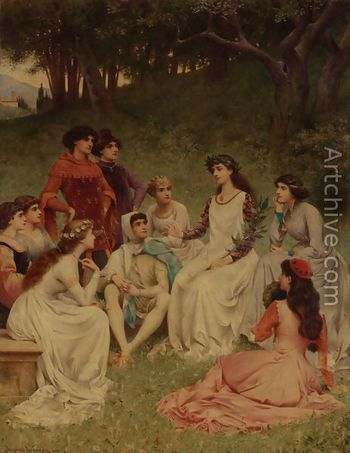
 “Storytellers, through their stories, can enter into our imagination and interact with our deepest human emotions.” Donald L. Hamilton
The above quote reflects some of what I hope for as a storyteller. I’d like to be able to convey meaning, understanding, entertain, interact, and teach with my stories.
We humans have the unique ability to communicate with each other with what began by utilizing complicated language. We are also able to utilize what other species don’t have: imagination. Thus, we can not only communicate and relate, but can also share information, emotions, and imaginative ideas with each other.
As the ability to communicate improved, groups of people told stories to one another in every culture and clime in the world. In time, storytellers emerged who would not only communicate, tell stories, and keep and relay the history of the people, but often direct the actions of the group. Sometimes this was good, sometimes not. The storyteller had a lot of power over the people, and this power continues today not only in storytelling performances and other venues, but with the written word came the ability to communicate even easier and brought us to the media-saturated world we live in today.
Magazines, newspapers, books, the internet, television, movies, music and other genres all tell stories, and paint powerful pictures that certainly affect the opinions and lives of those who read, watch and listen to the stories they convey. I think the imagination once employed by story listeners has been diminished. The media storytellers of today often leave nothing to our imagination, shoving ideas and images down our throats as it were. So now, through experience and research, I am learning more about the positive power of true oral storytelling.
In my quest for stories, I’ve needed and wanted to find good, real, stories to tell. Sometimes this has required research not only to find the stories, but also to learn more about the history, region and culture surrounding the story. This research helps me to better understand the people, and understanding the people helps me to better understand the story and its meanings. Thus, my research of France led me to the Chauvet Cave paintings.
In earlier times, people used drawings to communicate information as well as tell stories. In France, about 34,000 years ago, some people created pictures on the walls of some caverns/caves. These images were discovered in 1994, and are believed to be the oldest known cave paintings.
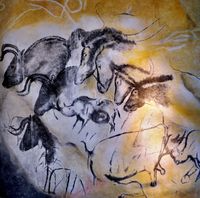 Seeing the pictures of the caves was inspiring to me. I think that people may often relate verbal communication and written language with intelligence, but looking at the many paintings, it is easy to see that these early people were very intelligent. (I’m pretty sure they survived better than I would have in that environment!) These paintings tell more than stories … they are a fantastic link to our human past, and give me a feeling of ‘connection’, not only to them, but to everyone. That feeling of connection is one I feel during the best of stories; the connection to someone else, real or fictional, and it’s a powerful feeling of oneness.
I am still coming to realize the power a storyteller can wield. To control anyone has never been my intention; my intention has been to be of service, assistance, and entertainment.
Through the centuries, storytellers have not only related stories, but have been the creators of traditions, morals, rules, laws, religions, rituals, superstitions, myths, etc. And all these came from the storytellers’ imaginations and experiences. History has been full of great storytellers who influenced people for good, and there have been those who have influenced the people for bad, causing hate, devastation and war.
I think that the need for storytellers today is increasing. We need positive thinking, inspiration, healing, peace, encouragement and sometimes even laughter, to help us make sense of our complex world, and see how alike we as humans really are. Through storytelling we can learn, experience, understand, and share with each other, thus bridging the gaps between us.


Leave a Reply