The Triangle Shirtwaist Factory Fire by Joan Misek


A couple of months ago I received my copy of the AARP magazine.  Inside I found an article entitled "The Education of Frances Perkins.” The article stated that Frances Perkins became an activist because of the Triangle Shirtwaist Factory Fire on March 25, 1911.

When I was seventeen my parents moved to upstate New York to start a dairy farm.  I moved into their friend's house to rent a room with kitchen privileges.  I met another tenant named Anna. Anna, who was in her 50's, and I became friends.  She was a member of the ILGWU – International Ladies Garment Workers Union.  She was the first woman I ever met who was an activist.  She fought to end child labor and she fought for women's rights.


Anna was the one who told me the story of the worst fire in the history of New York City long before I ever read about Frances Perkins. Anna was a great teacher. I was never able to forget this story about the Triangle Shirtwaist Factory Fire that she told me when I was a teenager.

It was a Saturday afternoon in New York City.  A fire broke out in a bin filled with fabric.  The factory occupied the eighth, ninth and tenth floor of the Asch Building.  Those on the tenth floor escaped across the roofs.  Those on the seventh floor ran down the main staircase.  Those on the ninth floor were young girls from ages 15 to 23.  They were locked in so they wouldn't steal.  They worked seven days a week, 7:00 a.m. to 8:00 p.m. with a half hour break.  They were paid $6.00 a week.

The fire engines were called, but their ladders only reached the seventh floor. Their nets were flimsy.  When the girls jumped they went through the nets. The one fire escape was also flimsy and bent from the heat.  The elevator stopped due to heavy loads and some girls jumped down the shaft to escape the flames.  Forty-nine girls and a few men stood on the window sills. They knew if they jumped they would die.

The flames built up behind them.  Soon one jumped then a group of three jumped holding hands. If they landed on their backs they could be identified. If they landed on their chests they might be identified by clothing, dentures, or not at all.

The trial of the proprietors resulted in an acquittal.  They were compensated for their losses by the insurance companies, and they moved their operations to another building.  In 1914 they were ordered to pay damages of $75.00 each to the twenty-three families of victims who had sued.

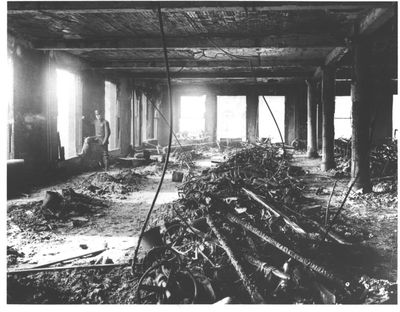
(The image at the top of the post shows the aftermath of the fire on one the factory floors.)

9 responses to “The Triangle Shirtwaist Factory Fire by Joan Misek”

  1. Marian Giannatti Avatar
    Marian Giannatti

    This makes my heart hurt. I remember learning about the factory fire in history class. How sad that people don’t take notice, and policies don’t change until there is a disaster. I am still surprised at the acquittal! You were fortunate to know someone who played a part in changing labor laws and improving working conditions for women. Telling this story truly does remind us that all lives matter, and that workers must be treated fairly. Thank you for reminding us, Joan!

  2. Laurie Provost Avatar
    Laurie Provost

    Great story Joan. I didn’t hear about this until sometime in the last several years and had forgotten how horrific it was. Your story and memories of hearing about it from Anna remind me why I am an activist and why I will continue to help protect people from treatment like this for as long as I am able. Thanks for sharing!

  3. Laura Rutherford Avatar
    Laura Rutherford

    I am always amazed how a story has the power to reveal or rekindle powerful emotions. This is why storytelling is so important so that we remember that which MUST be remembered. Thanks Joan.

  4. Susan Malmo Avatar
    Susan Malmo

    I love the fact that you’ve used this very sad, sad story in an uplifting way — the fact that these events eventually caused people to become committed to creating positive change in the world gives me hope that things work out in the end.

  5. Pina Avatar
    Pina

    Joan , I finally got a chance to read this. Wow! Those young girls. That low pay and such hArd work. Fires. Activism. Women. I love your stories Joan. I befriended a older woman a couple years ago from Ukraine. She passed away soon after. Thank God she did before all that Fire in Ukraine. Fire a metaphor. Her stories though stay with me as yours do. Thank You for the gifts you bring our way in Story Telling.

  6. Crystal Gale Avatar
    Crystal Gale

    Joan, the story of this fire needs to be retold in this nation. So many have fought hard and even died for laws prohibiting child labor, for fair labor laws, and for safety in the workplace. Where are we today? Our clothing is made in China and other countries where laws protecting workers do not exist. Trade laws allow Americans to wear seemingly inexpensive clothing made by people in horrendous working conditions. Many of the clothes made in the Middle East are made by Asian workers who are essentially held as slaves on compounds. The stories can bring change. They just need to be told. Thank-you Joan!

  7. Sharon Gilbert Avatar

    Joan, thank you for sharing this story. This is history that needs to be heard! Well done.

  8. Leticia Avatar
    Leticia

    I was told that history was a class I had to take in school. I didn’t care for it. Then as an adult I wanted to learn some historical stories for a storytelling program, and so I researched the past. It turns out history was what the elders in my family were sharing through their stories. I realized I really do love history and always have. The teachers I had for history had no idea how to make the connection between history from the book and their students. You on the other hand tell such compelling tales with such style. Thank you for making the past come alive through your stories.

  9. Nancy Wolter Avatar
    Nancy Wolter

    Appalling, terrible, awful story, and how moved you must have been to hear from someone so close to it. Sometimes we think what a long long way to go before there is a greater understanding and empathy for all, but looking back at our human history, all change, though seemingly incremental, points toward the arc of justice.We must grow our hearts, or lose them forever.

Leave a Reply

Your email address will not be published. Required fields are marked *