 One of the readings I did for class was from Inviting the Wolf In: Thinking About Difficult Stories, by Loren Niemi and Elizabeth Ellis. They write that there are three basic principles that make up the foundation for the telling of difficult stories: trust, permission, and ownership. I considered this foundation as I looked back on a difficult story I told last fall in Personal Storytelling.
The difficult story was about my mother. I realized before we knew she was dying, that my family would one day ask me to speak at her funeral. After all, I’m the storyteller, right? At the time I had that realization, I couldn’t think of anything nice to say about her. She was such a crab! In an effort to connect with her over the years, I had written long letters of my adventures and she barely acknowledged receiving them. What nice things could I possibly say about her if she died? The story starts there, progresses to her diagnosis with cancer only a few months later, and my visit home – where she was in denial. It continues with me writing letters to her (of course!) after I return to Arizona, acknowledging her for some pertinent things she taught me. The joy of singing in the car, the love for wild birds, and the delight of performing in front of people. In the end, she seems to postpone her death until I can get back to Minnesota, dying just 12 hours after I return home. I speak at her funeral and have thought of some nice things to say. Months later, I go home to visit. My sisters have cleaned out her stuff, and I find that she had been saving letters from me for 30 years. Two shoeboxes full! But the story doesn’t end there. I make one more visit back home that summer, where my sister tells me we are going to plant a tree on the golf course in her honor. It was a tradition among her golfing friends to honor the deceased by planting a tree and she had told them exactly what tree she wanted when she died. My sister and I planted the tree and put up some birdhouses to remember her. And the tree my mother picked for herself? A crab apple tree!
So let’s take that story and talk about trust, permission, and ownership – using prompts from the book.
What are the elements of trust (for myself and my listeners) are necessary to tell it? First, I had to be okay telling the story. I had to trust that I wouldn’t burst into tears and be unable to finish it. I had to trust that I could be honest about the way Mom was, without painting her in a bad light. I had to trust that the listeners wouldn’t think poorly of her after hearing my story. There was probably some trust between the listener and the story that it wasn’t going to leave them hanging with unresolved issues.
When or where can it be told? This story could be told almost anywhere. It’s mostly a story for grownups, but there were younger folks present when I told it at Thanksgiving last year. I didn’t think it was inappropriate for them to hear, but they probably lack the experience and wisdom an older person does to really appreciate it. Different ages might appreciate the story for different reasons. In a program, I would probably follow this story with something lighter, to leave people in a good place – although the ending, with her choosing a crabapple tree, is a pretty good spot to leave them. This is not such a difficult story that it has to be kept from certain audiences. If it was a story abuse, the options of where to tell it, and what ages to tell it to, would be more limited, given the subject. But that too, depends on how it’s presented. Graphic details, or leave it to their imagination? I considered this an appropriate story to tell in a family setting, to people who either knew her or at least knew of her. But it’s not limited to a family setting by any means.
What are the elements of permission in those relationships? I gave myself permission to tell it, even if it might bring tears to my eyes. My mom is gone, so I didn’t need her permission – but before I told it at Thanksgiving, I asked my step-dad if he was OK with me telling a story about her. I didn’t want him to be surprised when I suddenly dropped in a “mom” story, or for him to feel fragile and not want to hear it. He assured me that it was OK, and I believe he was honored that I asked, and honored that I have a story about her. I didn’t consider it at the time, consciously, but I surely asked myself if this story would go over with this audience. It was a family reunion, many knew her, and it was a story about how I came to resolve some of the difficulties with her. The humor is important in this story. People laughed and cried in the same story, which, to me, is an indicator of a good story. And I left them laughing at the end, so I felt positive about it.
In what ways do you own it? I’m very comfortable with this story, in that I acknowledge the difficulties I had with my mom, but in the end I was able to come to terms with it all. I was able to write letters to thank her for what she had taught me, and I was able to be there for her in her final hours. I actually think that by crafting the story, it helped me to bring closure to the difficulties I had with her throughout my life. In the crafting, I really realize the good she taught me, and that she didn’t mean to be difficult for me, it was just how she was. I came to really appreciate the fact that she saved all those letters. My only regret is that I didn’t know this while she was still alive, but that’s minor.
What language or images are specific to your understanding and sharing of this story? Since it’s my story, I use my language – it’s not like I’m telling someone else’s difficult story and have to be careful how I portray it. I’d say my language is frank but my tone is soft. When I tell the part where I worry that they’ll ask me to speak at her funeral, I tell my friend “I can’t think of anything nice to say about her.” That’s bare bones honest about how I felt, but I don’t say it in anger – it’s just a fact. When I tell about her yelling at the dog, “What the hell are you doing in here, get out!” that language was HER. I couldn’t have said “heck” and made it sound like my mom! For those who don’t know the story, the neighbor kid thought Mom was yelling at HIM, and he skedaddled out the door! The image of shoeboxes full of letters is an important one, showing how she cared without being able to let me know. And the image of her choosing a tree to plant in her honor at the golf course was very important – and funny.
Trust, permission, and ownership came to play in a story that was difficult, but very important for me to tell. While I didn’t consider these things on a conscious level as I crafted and told the story, they were all there. Being conscious of these elements in future stories is a way I can ensure that I successfully craft those stories as well.
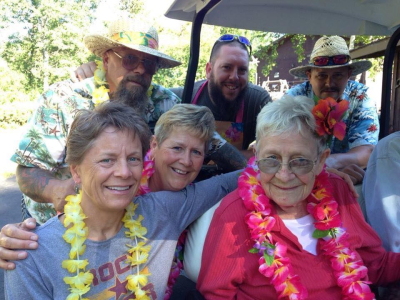
(The image at the top shows Sally on the lower left and her mother on the lower right at her 80th birthday party.)


Leave a Reply