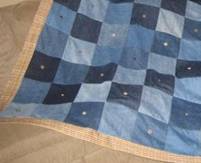
 Quite a few years ago, I decided to make tied quilts for my kids from old jeans.
I had been saving my husband’s discarded jeans for years, and adding to the stash from my kids and other family and friends. I used a Golden Book as my template to make the blocks. I figured these little storybooks would always be around, so I could always find a pattern. Unfortunately, the economy has shrunk even those tiny treasures.
My store of old, well-worn, pants was huge. I began to cut out quilt blocks. I laid out the pattern, and cut. I cut, and I cut, and I cut. I got blisters on my hands, fabric dust and threads everywhere, and still I continued to cut.
Over many months, the pile of pants went slowly down. I cut out and saved the important parts, and cast the unimportant parts aside. The pile of those important parts – the blocks – kept rising. When at last the cutting was complete, I had taken a huge amount of pants and transformed them into a good sized pile of neatly trimmed blocks. I hauled the useless parts off and began to sew the blocks together. Sewing the blocks together was fun. I simply sewed one to the next to make a long strip.
When all the strips were complete, the task of sewing the strips together into four separate tops commenced. Each time another strip was added, the quilt top grew not only in size, but began taking on a dimension and pattern of its own. Sewing the last couple of rows together on each quilt top was bulky, so I took care to guide this bulk through my machine, so as to not break a needle. At last, I had four quilt tops! Hurrah!
I’d already carefully chosen the backing fabrics for the quilts (all flannel and all different). I sewed that fabric together then assembled the layers that would become the quilt. I put the back on the quilt frame (pattern side down), then the batting (inside fluffy part), and lastly the pieced top (pattern side up).
‘Tying’ is the act of actually sewing the layers together. This was the easiest and quickest part. I threaded my sturdy, large-eyed needle with a long piece of yarn, and made one stitch in the center of each block. That stitch went all the way down through my quilt and back up, sandwiching the layers together. I knotted the yarn and moved on to the next block leaving a trail of yarn attached from the previous stitch. I loved to snip the yarn in between the stitches, thus making the individual ties stand out. Lastly, I removed the quilt from the frame and ‘bound’ the edges of each quilt, folding the back (flannel) part over the front and hand stitching this to the front. The corners were the trickiest parts, but I managed the turns gracefully. The finished quilts were great, and have wrapped my children and grandchildren in warmth and comfort for years.
I relate this story of assembling the quilts that I might liken it to my search for stories. My recent search has included stories from France and information about the history, culture, geography, and customs of the people. As I have worked on this project I’ve amassed a considerable amount of information. I’ve examined each piece, looking for the most important things to complete each layer; the beginning, the middle, and the end. I hope that my telling will bind it all together with strong threads: the ties of story that bind us all together; our hopes, fears, joys, tears, loves, losses, challenges, and the humanity we all share.
As with my quilts, my stories are a lot of work, involving much time and effort, but the yield is much the same: the rich echo of history, love, family, and the amazing feeling of warmth and safety shared …while nestled in the comforting folds …of the story.


Leave a Reply